
PlayStation's last disc
The economics are cheap. Loyalty is expensive

The SuperJoost Playlist is a weekly take on gaming, tech, and entertainment by business professor and author Joost van Dreunen.
Three weeks upstate, the tally is starting to take shape.
So far, we’ve counted three different bears, a smattering of deer, one hare, a fisher cat, too many chipmunks, and a gopher, which, you should know, has been reclassified by the four-year-old as capybara.
Do you know what I did not see? A single Argentinian winning the World Cup.
On to this week’s update.
BIG READ: PlayStation’s last disc
Being right isn’t always what’s best for a relationship.
In PlayStation’s case, getting rid of physical discs makes perfect business sense. It improves margins, reflects how consumers have been buying video game software for years, and removes several important friction points.
And it left its most passionate fans feeling completely unheard.
In making what seemed like a straightforward, informed business decision, Sony inadvertently finds itself at the center of a classic platform economy problem. How much should a platform optimize its own economics if doing so alienates the players who sustain it?
On paper, Sony is perfectly executing its business goals.
For instance, one of Sony’s competitive advantages over Xbox has long been its command of its value chain. As a consumer electronics firm, Sony has established a broad global network over the years to sell not just its PlayStations but also its televisions, audio equipment, Blu-ray players, and music albums.
That universe is shifting.
Disc sales peaked in 2008 at about 402 million units worldwide, carried by the Wii, the PS3, and the Xbox 360. Since then, however, they have fallen almost every year, to 82 million in 2025, a decline of roughly 80 percent. In contrast, digital downloads surpassed discs in 2019 and reached 382 million units last year. Even the cartridge, which was given a second life by the Switch, peaked in 2021 and is fading again.
You can clearly see the outline. Rather than ending the disc era, Sony has reached the end of a thirty-year transition that began when it abandoned cartridges for CDs.
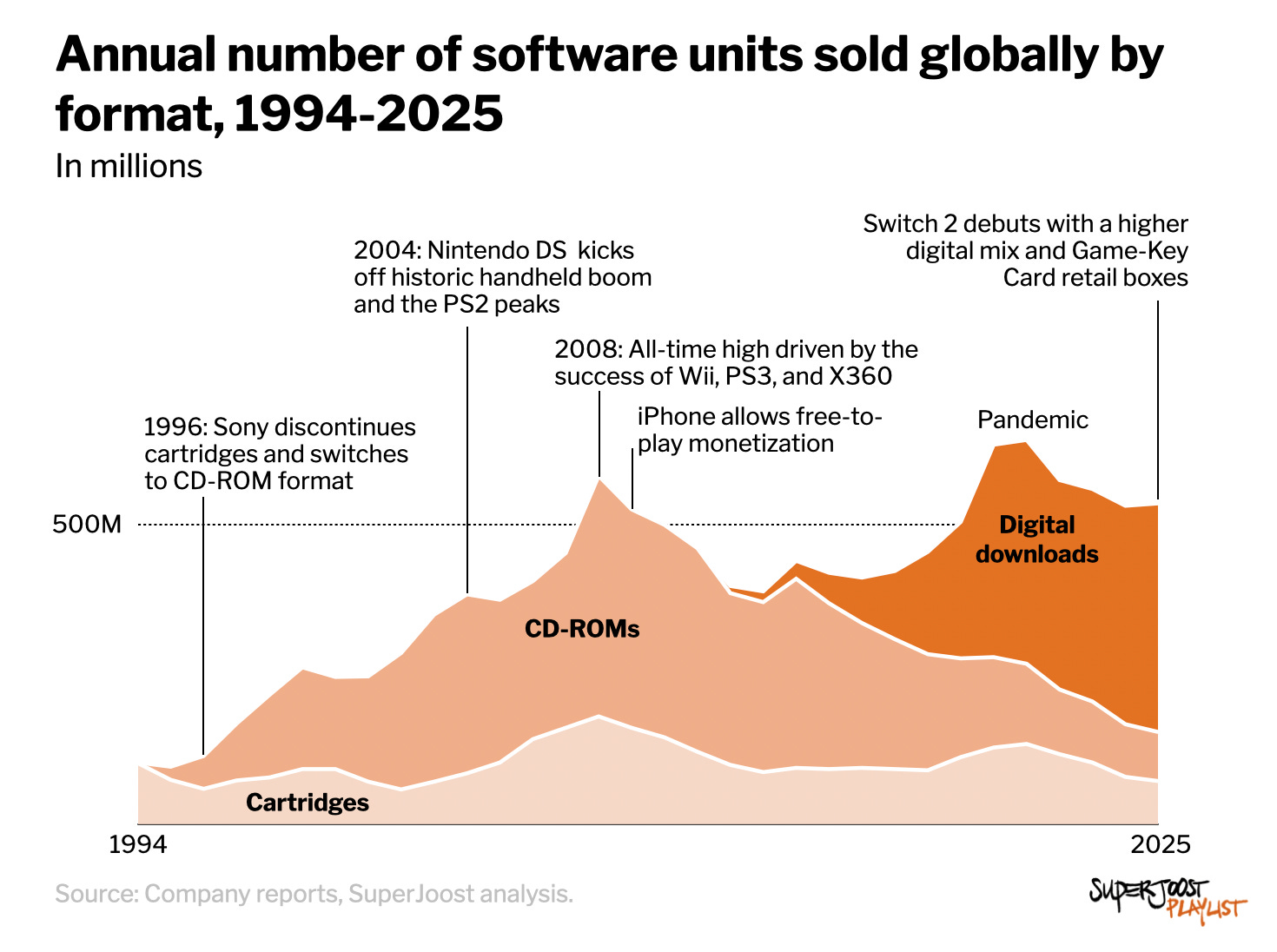
Discs overtook cartridges in 1997, after Sony discontinued its cartridges in favor of the CD-ROM. A cheaper format with better economics displaced an incumbent that had grown expensive and constrained. That same trend is now happening to discs as digital downloads prove cheaper to deliver and impossible to resell.
Regular readers will observe that all this fits neatly into my Play Pendulum theory. The games industry alternates between periods of content innovation and periods of distribution innovation roughly every decade, and we are firmly in the latter. When growth slows, firms stop chasing new audiences and start re-engineering how, and at what margin, they reach the ones they already have.
Originally, the disc itself was a distribution play. The CD-ROM’s cost-efficiency let Sony crash the console market in 1994, and the margin it freed up bankrolled the content boom that followed, from 3D worlds to cinematic storytelling. A distribution breakthrough set the stage for the next content wave. Three decades later, the disc dies the way it was born: as a distribution play. The difference this time is who benefits. Historically, distribution swings favored newcomers, as Steam was in the last one. This time, it is the incumbents capturing the value.
Part of that is practical and has to do with the creative ambition of the games industry. Especially marquee AAA titles have the terrible habit of becoming larger with each release. In fact, it is a well-documented principle that file sizes expand, even more so for blockbuster releases.
Another reason is that the global value chain has changed, too.
During the pandemic and the most recent spike in oil prices as a result of the War in Iran, it has become painfully clear what some of Sony’s weaknesses are. The cost of shipping discs and consoles, for that matter, halfway across the world, is variable and heavily dependent on the price of oil.
Worse, because of the Japanese economy’s reliance on imported oil and domestically low interest rates, the Yen is at a 40-year low. That further increases the costs for manufacturing and shipping products, and eats into Sony’s margins.
It doesn’t help that one of its primary markets, the United States, has spent the past two years fencing with tariffs. The uncertainty rippled straight through to sticker prices, and in Nintendo’s case it has now curdled into a lawsuit from consumers who feel slighted.
Succinctly, Nintendo raised prices when the tariffs hit. Then the US Supreme Court struck the tariffs down in February, after which Nintendo sued the government to get its money back. When players asked for the same courtesy, however, the company moved to dismiss, arguing they “received exactly what they bargained and paid for.” The tariff refund flows one way. Players ate the increase while Nintendo collected the rebate.
Which brings me to a key point in Sony’s decision: none of the savings are passed on to consumers.
What’s not to like
Bloomberg games journalist Jason Schreier argues that Sony’s decision is best understood as a straightforward margin play. The firm’s official explanation—that it is “aligning” with how players prefer to buy games—is a thinly veiled excuse, according to Schreier.
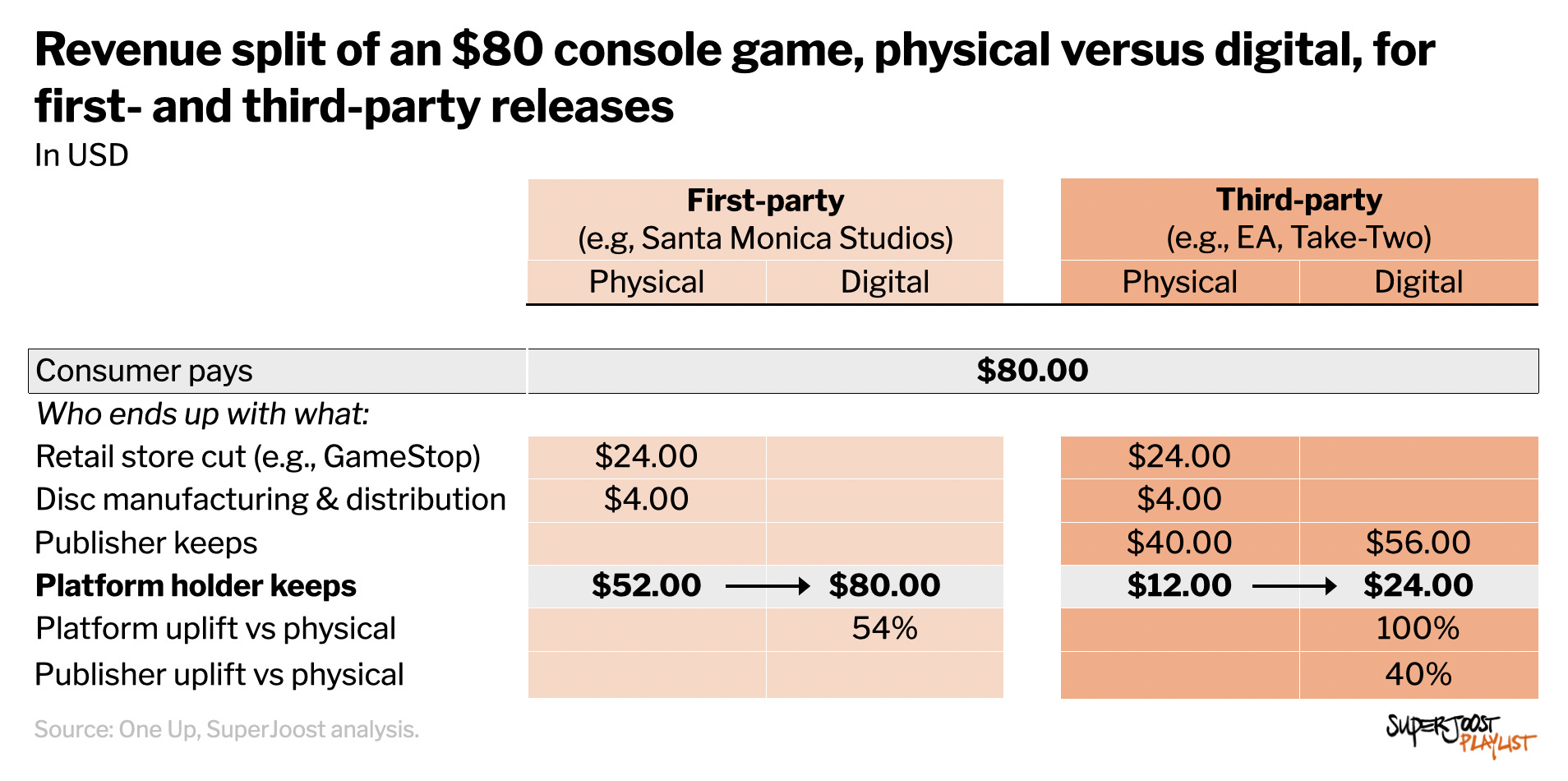
Walking through the revenue split of a full-priced game, he shows how the money that once went to retailers and disc manufacturers now flows to the platform instead.
Updated to today’s $80 price point, the math looks like this. On a first-party disc sale, Sony nets about $52 after the retailer takes $24 and disc manufacturing another $4. Sold through its own store, it keeps the entire $80. On third-party games, its take doubles, from a $12 licensing fee on a disc to a $24 store cut on a download. Either way, the consumer pays the same $80.
Part of how you know this is a straight margin play is that especially big publishers stand to gain, too, and have subsequently been noticeably quiet.
Here’s what that looks like.
Take-Two’s release of GTA VI later this year takes place first on console. It is anticipated to have a blowout launch. The game’s release doesn’t rely on brick-and-mortar retailers for the lion’s share of its sales. In 2013, when its predecessor came out, consumers bought 284 million games on disc, accounting for 73 percent of annual sales. If we assume for a moment that the upcoming release sells as many copies in its first year as its predecessor, these different ratios net Take-Two an additional $430 million in its first year, without selling a single extra copy.
Quick math says that in 2013, Take-Two kept roughly 52 cents of every dollar GTA V earned at retail. The rest went to the store, the disc plant, and the platform’s licensing fee. Under today’s mix, with most copies sold as downloads and the remainder as key codes in boxes, it keeps about 68 cents. On a $2.8 billion launch, those 16 percentage points amount to $430 million. Add the price increase from $60 to $80 and a slightly higher unit forecast, and Take-Two’s first-year take for GTA VI roughly doubles compared to its predecessor.
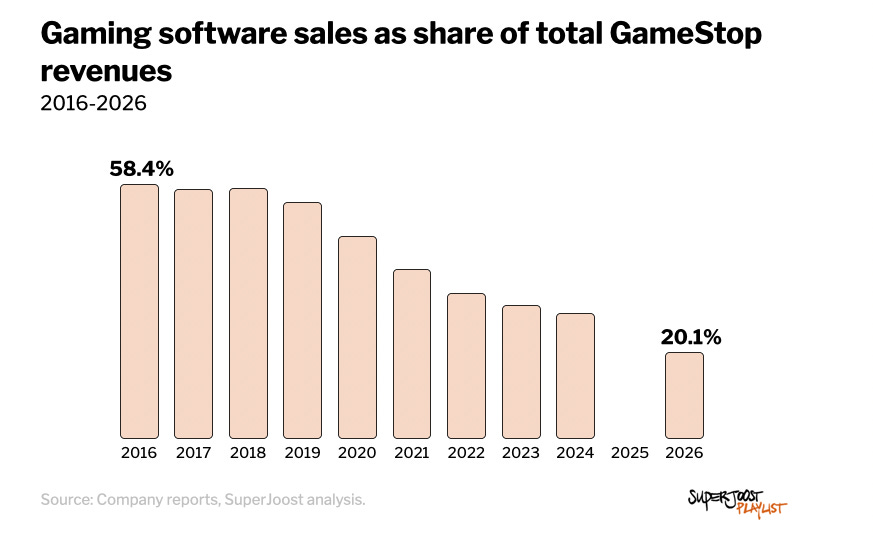
Another consideration is the diminished role of retail. For years, physical brick-and-mortar stores were a key part of pre-ordering, marketing, and selling upcoming titles. Among them, GameStop has clearly lost interest.
Its software revenue fell from $3.0 billion in the year ending January 2020 to $729 million in its most recent fiscal year, a decline of 76 percent. Games now account for only a fifth of its sales, trailing not just hardware but collectibles. Over the same stretch, its store count shrank from roughly 5,500 to just over 2,200. Taken from this angle, more than cutting out a thriving channel, Sony is foreclosing on an atrophied distribution network.
Across the board, each of these changes improves the economics. But what, exactly, does it leave for the players?
Schreier also points out the real costs to consumers: the increased challenges around preservation, the disappearance of the used-games market, and the inevitable impact on library collections. By retiring physical discs, Sony is impacting several key cultural practices that may not have contributed financially, but certainly contribute to the broader experience of interactive entertainment.
And while I agree with him, I also don’t think he’s taking this far enough.
Beyond trying to capture a bigger margin and, inadvertently, shutting out existing consumer behaviors, a disc-less future is more dystopian still. According to some, it’s a clear erosion of property rights in the digital economy.
Drawing on James Boyle’s idea of a “second enclosure movement,” Matt Stoller frames disc-less gaming as the latest fencing-off of a commons. Alongside Kindle books, John Deere repair locks, and deleted movie libraries, he emphasizes that the disc’s disappearance removes a secondary market that once acted as a competitive check on increasingly vertically integrated platforms. But because the Digital Millennium Copyright Act makes it a felony to circumvent digital locks even on products you own, consumers have no legal standing.
Platform culture
All of that makes business sense, yes, and improves financial margins.
But there are high intangible costs, and their importance is both hard to quantify and dismiss. It is emblematic of a broader problem that has emerged with the prominence of large tech firms in cultural industries.
Its two main rivals, Xbox and Nintendo, provide further evidence. Within her initial 100 days, Xbox’s new CEO announced that she was lowering the price of Game Pass Ultimate. It instantly won her the necessary goodwill and trust, despite being an outsider to the games industry. Moreover, permanently lowering the price of an entertainment subscription hadn’t really been done before, which meant the decision was carving out a potentially new path in how platform operators relate to their players.
And Nintendo, knowing its audience, launched the Switch 2 with game-key cards, cartridges that contain a digital license instead of full game data and trigger a digital download. It’s a bit like buying a box of mac and cheese where you still feel that you’re preparing food, but you’re also not really cooking.
Digital downloads have the added benefit of running smoother than physical carriers. Loading times at startup can be cut in half, and in-game loading screens (e.g., during fast travel) are shortened. Moreover, many of the biggest titles today are so large, sometimes a few hundred gigabytes in size, that even if you bought it on the largest available Blu-ray disc, you’d still have to install at least that amount via the internet.
Nevertheless, both Xbox and Nintendo made a conscious decision to accept a lower margin to make their players feel heard and to not alienate them with corporate efficiency. Video games are a cultural industry, and what Sony seems to have overlooked in its announcement is any semblance of concern for its constituents.
There’s an irony here that Sony knows better than anyone.
In the 1980s, it lost the Betamax war by maximizing its take, but won the Blu-ray war two decades later by doing the opposite. Sony subsidized a disc drive in every PS3 and shared margin with studio partners until the ecosystem tipped in its favor. The very disc Sony is retiring in 2028 exists because the company once believed adoption mattered more than margins.
Margin call
Sony and its peers are improving their margins, and, as a result, the physical disc has become too expensive to justify. The last plant still pressing PlayStation discs, in the Austrian village of Thalgau, is already being retooled to make optical lenses for carmakers. That decision likely predates the announcement by years, and it will not be reversed. The question is no longer whether the disc survives. It is what, if anything, players get in return.
Three things I’m watching.
First, there’s still time for a follow-up announcement that wins people back, and I’m not sold on the idea that a disc drive disappears entirely. Sony already sells an add-on drive for the all-digital PS5. An external option for whatever comes next would preserve the collector market at trivial cost, the way external drives lingered for years after Apple pulled them from its laptops. If the timing of this announcement was meant to clear the ground for new hardware, the make-good may already be sitting in a briefing deck somewhere.
Second, I predict a bundling of entertainment services. Sony is the only firm in tech that owns a successful game platform, a film studio, a music label, and the world’s largest anime service, and it still sells them separately like a food court. If the savings won’t show up in prices, they can show up in the offer. Fold Crunchyroll, the catalog, and day-one access into one subscription and an all-digital PlayStation starts to feel like more value instead of less ownership.
Third, Sony should, and hopefully will, do the cultural work. This ham-fisted playbook was written by tech firms that never understood cultural industries, and Sony should know better, because, by its own admission, it isn’t one. Its track record says the same. The future of entertainment is about building audiences, and owning the transaction is not the same as owning the relationship. Xbox and Nintendo both paid real margin this year to make their players feel heard. That money bought something no store cut can: trust.
To do that, all of these legacy platform companies have to consider what it means to participate in cultural industries. Ignoring it will give players a reason to move on, into the arms of another.
Sometimes the right answer is to listen better.
PLAY/PASS
Play. It’s fascinating to observe Ryan Cohen’s persistence in his bid to have GameStop acquire eBay. He’s terse in broadcast TV interviews and noticeably less hostile when talking to YouTube retail investors.
Pass. The ESA declaring private Minecraft “illegal” invites a deeper investigation into what exactly is going on. More than a poor choice of words, it was an instance where the trade group’s underlying priorities slipped into public view.
NEXT UP
With Gamescom one month out, I’ve just secured my flight and hotel room. I have big plans this year, and hope to see some of you there!
Game Pass subscription reduction as pro-consumer is missing the point I think.
That "price reduction" was done by removing the single most valuable thing in the subscription; COD from Day 1. The thing that probably justified recent price increases!
I would bet because they realized they are forgoing money on full-price sales and did not make it up in the hoped-for increase in Game Pass subscribers.
Microsoft is not doing this to "accept a lower margin" and framing it as such to emphasize the point re Sony somewhat undercuts your argument.