

Sharma's next 100 days
Honeymoon's over

"Optimism and realism." That's what Asha Sharma asked of Xbox staff in a memo on June 10th. It's code for: you're not going to like what I'm about to say.
She may have well told everyone, “The honeymoon is over.”
After more than three months defined by a growing infatuation with Xbox’s new CEO, the industry is sobering up. Layoffs are coming, and on Friday, a rumor surfaced that Microsoft may yet spin off Xbox entirely. Since then, Bloomberg reported that several of Xbox’s subsidiaries are now in negotiations to buy themselves out.
All of it falls in line with my initial predictions at the start of Sharma’s tenure.
While a spin-off is unlikely to happen anytime soon, the change in tone tells you where we are on the roadmap: after initially winning over skeptics and naysayers, Asha is now switching lanes to the unpopular part of the job.
We can see a first outline of how Microsoft’s gaming division is likely to change.
Succinctly, its former CEO, Phil Spencer, ran Xbox as a games executive managing a platform. Sharma, in contrast, is a platform operator running a games business.
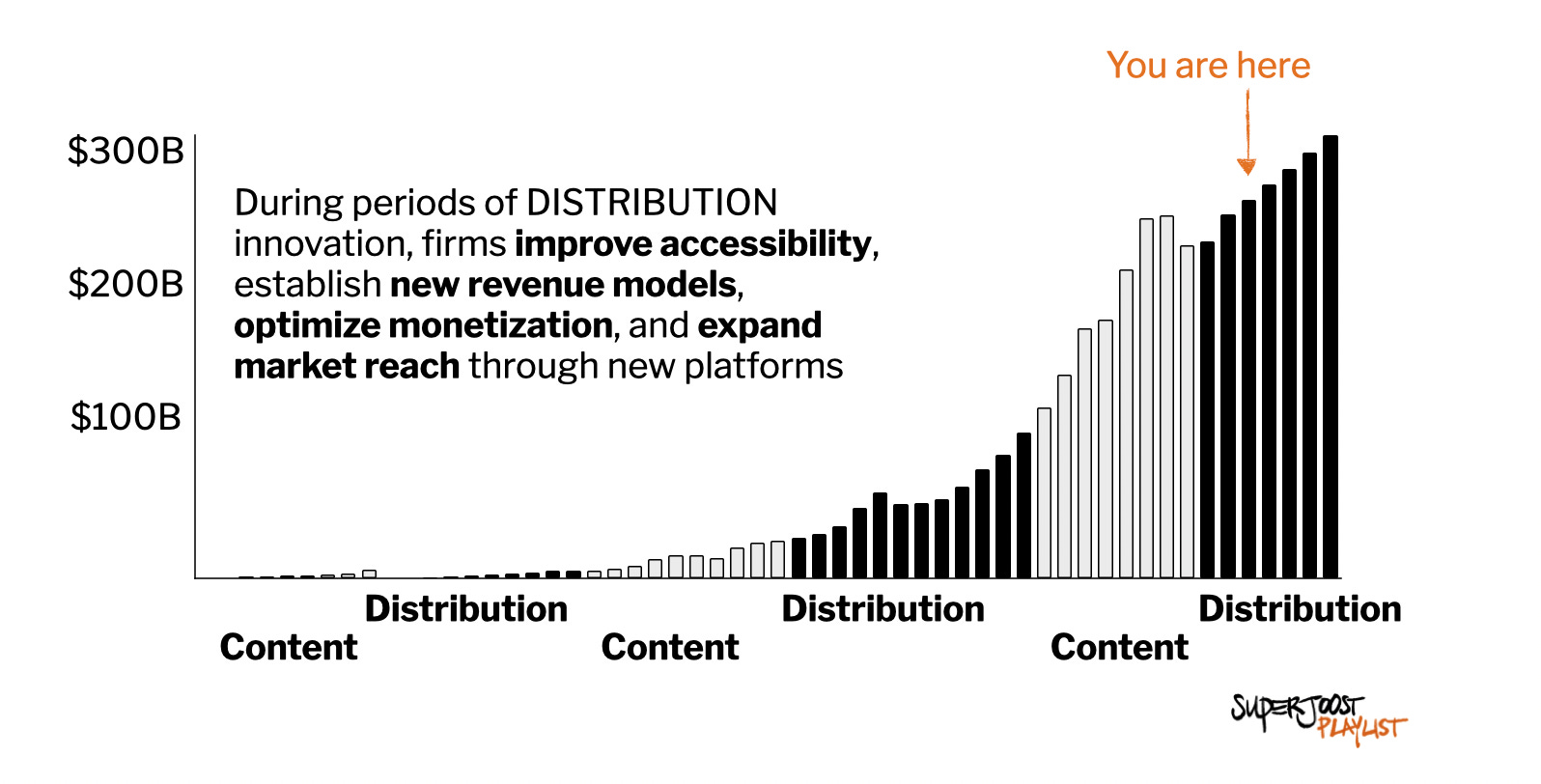
Viewed through the lens of the Play Pendulum, the distinction matters. I’ve long argued that games alternate between periods of content innovation and distribution innovation. During content cycles, success comes from making the next hit. During distribution cycles, success comes from making content cheaper, easier, and more accessible. Sharma’s Xbox increasingly looks like a company adapting to the latter.
Consequently, I predict that everything that follows from here echoes that principle. After sticking the initial landing, the next 100 days will give us a clearer sense of how Sharma imagines Xbox’s future.
Background
As one of the largest game companies in the world since the acquisition of both ZeniMax Media in 2021 and Activision Blizzard in 2023, Xbox is adjusting to its new economic circumstances. Having spent well over $80 billion on content acquisitions in recent years, the company's subscription-based service, Game Pass, has so far failed to deliver on its lofty goal of reaching 100 million subscribers. To address this, Microsoft recently removed Xbox’s entire management team, including its former CEO, Phil Spencer, and his right-hand, Sarah Bond.
The appointment of Asha Sharma as the new CEO was not without challenges.
Following an initial wave of obvious and largely misogynistic criticism, public sentiment turned in her favor. Her background as an operator at Meta, Instacart, and Microsoft CoreAI raised fears that she, a newcomer to games, would quickly move to centralize the entire operation around artificial intelligence. But she proved critics wrong. Her quick execution on key issues and improved transparency alleviated initial concerns.
Now, after her first 100 days as the new boss, Sharma is gearing up for the job she was actually hired to do: whip Xbox back into shape. The games industry at large is up 4.5 percent year-over-year, and Xbox's presence across PC, console, and mobile ostensibly means it can compensate for losses in one area with gains in another. But things aren't going to get better by themselves.
In a recent interview with Bloomberg, Sharma outlined the problem. Software sales had declined from $5.7 billion to $5.3 billion since last quarter, and hardware sales are down 33 percent. Xbox, she concluded, was "not in a healthy spot.”
She’s right, of course.
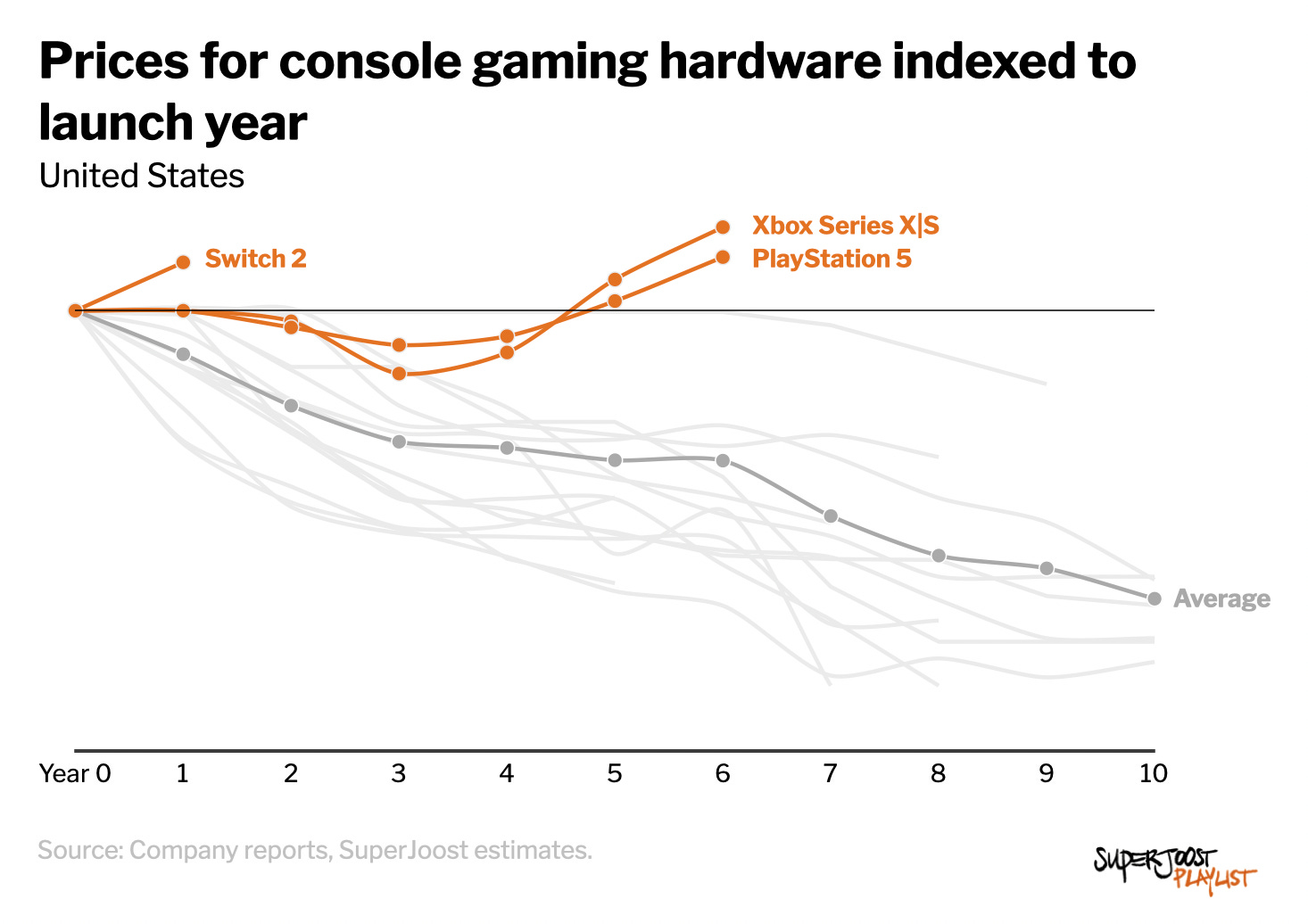
The cost of memory and storage has gone up almost 3x since she took the job, and console gaming, the “core” of Xbox, isn’t getting any cheaper. Despite all the price increases, both the Switch 2 and the PlayStation 5 are outselling the Xbox. Ironically, as the Microsoft mothership continues to pour billions into data centers and the chipsets to power them, its own subsidiary now faces shortages and high prices for hardware components. The chipmakers even have a phrase for it: they're "post-consumer" now, selling to hyperscalers rather than gamers.
It’s especially vexing this late in the console cycle, when console manufacturers historically cut prices to sway risk-averse buyers to finally upgrade their hardware. Xbox and its peers are forced to do the opposite, against their own institutional logic.
Opening move
Instead of trying to solve its issues with more and fancier technology, Sharma is focusing her attention on increasing the value of its ecosystem for both consumers and creatives.
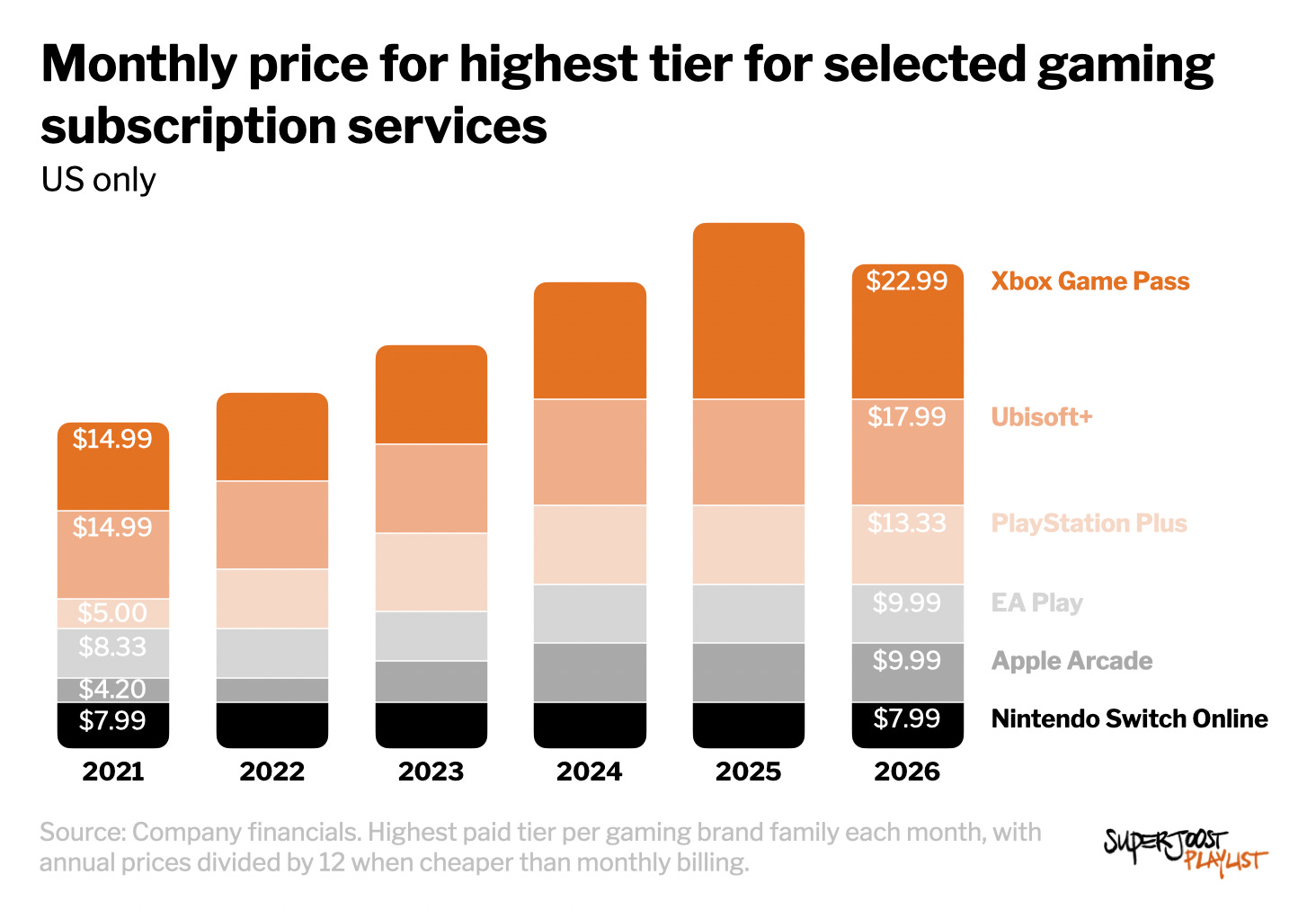
Her defining decision so far was the price cut. On April 21, Game Pass Ultimate dropped from $29.99 to $22.99. As part of the price reduction, new Call of Duty releases would no longer launch immediately on the service and would instead become available a year later. It means a cheaper subscription overall that offers less.
It worked, at least for now.
The service has since returned to growth, with improvements in both revenue and retention after an 8-month decline. It’s an important win for an incoming CEO and offers solid ground to build on.
But this is also where we see a stark difference emerge between the Spencer-era Xbox and Sharma’s vision of the future. Following Big Tech’s playbook, focused on economies of scale, has notable limitations in entertainment.
The decision to push into what Sharma called Xbox’s need for a “business model innovation” is the distribution phase in action. Now that Xbox, like everyone else, has to make sense of having previously bought all that real estate, the cost of entry goes down even as the hardware gets more expensive.
And now that a full-blown RAMpocalypse has arrived, sitting still isn’t an option. Says Sharma:
“It will require fundamental change in terms of how we innovate and how we think about the business models and how we go bring this to market.”
In the same memo, she put numbers on it: by the 2027 holiday season, she expects storage and memory to cost five times what they did in 2024, and conceded Xbox has been "impacted more greatly than many of our peers due to the choices we made over the last half decade." The next console, code-named Helix, will need a new business model and hardware partners just to ship.
The cloud ambition that justified the Activision deal is now scaled back and offers the sharpest break from the Spencer era yet. Xbox is now deeply dependent on its own titles to perform, and the studios it bought were often worth more independent than folded in. Ambition tends to dissipate once a studio becomes just another line within a conglomerate.
By now offering some of its more critically acclaimed studios, such as Compulsion Games, Double Fine, and Ninja Theory, to negotiate potential buyouts, Sharma is challenging a core assumption of the Spencer era. Owning more studios does not necessarily create more value.
Pay less
The decision to cut prices deviates from the usual tech-firm move, which is to subsidize growth early, then enshittify and raise prices later. Lowering the cost of your centerpiece subscription is uncharted territory.
Sure enough, a price cut tends to lift demand.
Gamers are infamous for finessing the cost of games, lurking in retail and digital storefronts until they spot a deal. The same crowd that will spend $300 on a mechanical keyboard won’t spend a dime on software, like a bunch of extreme couponers.
That much is obvious. What’s missing is a clearer understanding on the impact of price cuts for entertainment services specifically. So here’s what I’d expect, borrowing from streaming and telecom, where discounting is better documented.
First, subscribers who sign up convinced by a lower price tend to also show lower willingness to pay and higher churn. Discounts drive traffic, but the cohort quality drops. Players roll in, run through a month, and roll right back out. Such a strategy applies equally to subscriptions as it does to, say, user acquisition on mobile, where increasing the marketing budget to drive up monthly active players often obfuscates a decline in average spending. None of that should surprise Xbox, which has subsidized adoption for years and is acutely aware that players entering the ecosystem with discounts have a lower lifetime value.
Second, existing subscribers read a price cut as proof they were overcharged, and brand trust erodes. By removing Call of Duty from Game Pass, Xbox seems to have sidestepped that issue for now. However, as it sets out to renegotiate the value proposition of its subscription service, managing player expectations is crucial. In a market drowning in content, where the brand is the quality signal, any perceived dilution of value is a real cost.
Third, price cuts are a one-way street. Once you’ve lowered the price, raising it again without bleeding subscribers gets much harder. As a result, Sharma will have to look for internal efficiencies to maintain profitability. If you’re cutting prices, you have to reduce costs to maintain your margins. That math is obvious enough, but a new price is both a financial and a social contract.
Yes, the reset has slowed the decline. By cutting the premium tier and, by extension, conceding to players that Game Pass was overpriced, Sharma brings big pants energy. It also commits her to a cheaper Xbox, more or less permanently shifting the organization's focus.
The next 100 days
It would be naive to think that layoffs weren’t always coming.
To improve profitability, a for-profit organization cuts costs, lifts revenue, or both. Sharma has lowered the price of Game Pass and can’t easily raise it, while hardware costs are climbing beyond her control. That leaves reducing headcount as the quickest way to improve profitability and secure continued support from Nadella. Sharma laid out the case herself. Excluding Activision Blizzard, she told staff, Xbox spent more than $20 billion over five years on content, platform, and hardware subsidies while annual revenue fell by nearly half a billion. Spend up, revenue down. "This cannot continue," she wrote.
She doesn’t need to prove whether Xbox can become a platform. It already is. Rather, how much of its games business must be sacrificed to make that platform grow again?
The early signs were there, of course. In her initial memo, Sharma defined the terms for success: “Our new north star will be daily active players.” She could have said "units sold," or "subscribers." But the measure for Xbox’s success will be daily actives.
That writing has been on the wall for some time. Phil Spencer phrased it similarly in 2020, ahead of the Series launch, saying that Xbox's strategy "does not revolve around how many Xboxes I sell." The difference is that Spencer talked engagement while still running a games business. Sharma is rebuilding the business around engagement itself. Play isn’t the point of its ecosystem, but the mechanism that keeps people coming back. Asked about her mandate at Bloomberg Tech, she said it isn’t the roughly 30 percent margin Microsoft expects from software, “it’s to be the number one gaming and entertainment company.”
Xbox’s new frontline explains why Sharma is so focused on an ecosystem that pulls people back daily. It provides the necessary foundation to push into new pricing models.
One is advertising. As I argued a few weeks ago, Sharma’s background makes indirect revenue a likely play. Gaming captures roughly the same amount of attention as social media, and will supplement its existing microtransaction-based model with ads.
As hardware prices climb, subscriptions that recoup cost by showing ads get more likely, too. Microsoft already runs a serious ad business with LinkedIn at its center, and Xbox can borrow that muscle. Following Activision, its media division has grown increasingly open about putting ads in games.
The other is user-generated content. Just last week, Sea of Thieves announced its “Keys to the Seas” program, that will let players build and share their own experiences. It echoes Minecraft’s approach to modding, and it’s hardly alone. Xbox also owns The Elder Scrolls, which has leaned on its modding community for years. Instead of people scrolling endlessly through their friends’ online posts, pictures, and videos, the future will involve people sharing cool items and experiences they’ve created.
To bolster these revenue models, Game Pass will remain critical. Precisely because it provides players a low-risk opportunity to try games they’d otherwise ignore, Game Pass is a discovery tool. It removes an important obstacle, similar to the removal of delivery fees like, say, Amazon Prime or Instacart+.
A 2025 study tracking 14,000 Xbox players concluded that discovery is the Rosetta Stone to the Game Pass universe. Researchers found that putting a game on a subscription service is the single biggest driver of how much it gets played, an 80 percent lift, outweighing both quality and exclusivity. What you put on Game Pass matters more for engagement than how good it is.
Asha has a lot of eyes on her. With 837K views at the time of writing, her Bloomberg sit-down is the most popular video on the channel. Sarah Bond’s interview two years ago totaled 98K. The audience is paying attention. The hard part is that the next stretch is mostly bad news.
For Xbox, the Play Pendulum has swung. Spencer spent a decade buying content, and now Sharma’s task is to make distribution pay for it. Her first 100 days were about making Xbox cheaper. Sharma’s next 100 days will be about making Xbox smaller.
NEXT UP
I’m in Chicago this week to deliver a devastating state of play at Unreal Fest 2026 and skeptically eat a slice of that quiche-style pizza to serve up there.