

Prelude to divestiture
The post-Phil era points to Xbox's optimization, followed by a gradual sell-off
The SuperJoost Playlist is a weekly take on gaming, tech, and entertainment by business professor and author Joost van Dreunen.
Now, having survived my second snowpocalypse this winter, I’m ready for spring.
Brooklyn has started to thaw, and we’re able to walk outside again without the risk of frostbite. It’s all just in time before the next round of trips kicks off.
First stop, GDC.
The new schedule, starting earlier in the week, and the new layout (i.e., a smaller expo footprint) tell me that it’s not just GDC but the industry at large that is going through a transformation. It echoes later-stage E3, when publishers avoided the main venue and set up their own events nearby to save costs and improve the experience for everyone.
Over the years, the center of power in gaming has certainly shifted toward the moneyed class, as venture firms, banks, brokers, and large platform holders have become the gravitational center. At the same time, the cost of entry is prohibitively expensive, and for non-US travelers, the trip itself is now a high-risk venture. The inevitable end result will be either a complete transformation of the GDC format, which seems to have already started with its recent rebrand, or a scattering of conferencing energy across a multitude of smaller events around the world throughout the year.
We’re doing our part and hosting our annual happy hour again.
Hit me up if you’d like to join our Monday event when we’re taking over the Press Club near the Moscone Center (March 9th, from 6 to 9 pm). We’ll also feature several indie projects from the Game Design Future Lab and the NYU Game Center. (N.B. Paid subscribers to SJPL are automatically invited.)
And for a preview of my annual SXSW talk, I’ll also be doing a state of play at the CEO Cabal, a private gathering of industry leaders, as a warm-up.
Hope to see you there!
On to this week’s update.

BIG READ
Last week’s news that Xbox CEO Phil Spencer and several key executives are leaving signaled a strategic inflection point. Leadership turnover at this level rarely means continuity. It means Microsoft is redefining the role of its gaming division.
Naturally, a change of guard at the top of one of the largest gaming platforms, especially after going all out to acquire intellectual property and struggling to deliver the expected results, has raised a host of questions.
I've covered many of those previously, from why Xbox made deep cuts despite strong growth, to how Game Pass pricing revealed its struggle with high player costs, to Nadella's now-failed endgame in the wake of the Activision Blizzard purchase.
The news was nevertheless a bombshell and marks an important milestone for both Xbox and the industry at large.
We’ll start at the gooey center.
Over the years, I’ve met Phil and Sarah a few times and have found them both to be personable and candid. Phil, for instance, took me aside years ago after I presented a state of the industry to an audience of more traditional media executives for some feedback. We went back and forth on market definitions and on how best to help non-gaming execs understand our industry.
Similarly, Sarah took me aside after running the scripted part of our exchange to share some of her experiences of being thrust into the spotlight, quite possibly as the face of change at Xbox.
Yes, both are about as corporate as corporate executives go. But they were also in it for the games. Which is why their sudden departure is odd. For one, why didn’t Sarah get Phil’s job? Why are all of them leaving?
We find some answers in Xbox’s history.
Since its inception, Xbox has been tasked with accommodating a host of novel technologies as part of Microsoft’s ongoing, largely ineffective effort to dominate product categories. It failed to beat Nintendo and Sony in console gaming, missed becoming the premier digital storefront on PC (and lost to Valve), spent $10 billion to enter mobile, only to exit soon after, and couldn’t get live streaming off the ground. Even when Xbox pushed into cloud gaming, leveraging Azure, the results fell well short of its initial ambitions.
These mandates have generally meant that Xbox functioned less as a category winner and more as Microsoft’s experimental arm, adapting to whatever tech wave Redmond wanted to surf next.
And today, that mandate from the corporate office is clearly AI.
The appointment of Asha Sharma, who ran Microsoft’s CoreAI product division, makes that unmistakable. Hardly a gaming insider, Sharma brings the logic of a platform operator. Rumor has it that if she proves successful in this role, she may gain a line of sight on ultimately replacing Nadella.
And for the record, does it matter that the new CEO doesn’t play games? I don’t think so. And neither does Take-Two CEO Strauss Zelnick.
What does matter is the organizational shift.
Over the years, Xbox has evolved from a gaming business experimenting with AI into an AI platform that distributes games. As Microsoft reorganizes around AI-first products and compute infrastructure, gaming now sits downstream of that strategy. Where AI once served the gaming business, gaming will increasingly serve AI.
It personifies the end and the beginning of two eras: Under Spencer, Xbox tried to win in gaming. Under Sharma, gaming’s role is to strengthen Microsoft.
From this point of view, we can make a few inferences.
Prediction 1: Margins over matter
In the short-term, Xbox will be further optimized and focus on margin growth. Since Microsoft insists on a 30 percent margin across all its divisions, Xbox will be managed accordingly. That means single-digit year-over-year growth for the next few years. Given its modest share in the PC and mobile categories and the relative affluence of its console audience, the focus will go to console players. The business won’t double in size. It’ll improve margins, increase revenue, and report annual growth of 3 to 5 percent.
On target, and dull.
I’m hopeful that Matt Booty’s promotion to EVP and Chief Content Officer signals a balanced marriage between the business’s creative side and Microsoft’s tech DNA. Booty has led nearly 40 studios and earned the trust of developers across the industry. If Sharma represents platform discipline, Booty represents cultural continuity. The question is whether that balance is real or symbolic.
Don’t get me wrong.
The incoming exec team I’ve spoken to seems eager and disciplined. It might prove to be the shakeup the firm needs, and I’d love to be proven wrong. I hope this moment marks the beginning of a genuine process of renewal. But it has the hallmarks of a repositioning of Xbox from growth engine to efficiency engine—one focused on operational leverage, margins, and AI integration.
Next, the change in management revives a more pertinent strategic query.
Prediction 2: Divestiture
In the long term, I see two scenarios.
The first plays out internally: after a few years of optimizing the offering for subscribers and maximizing monetization, Game Pass will reach a natural plateau and fall short of its original ambitions.
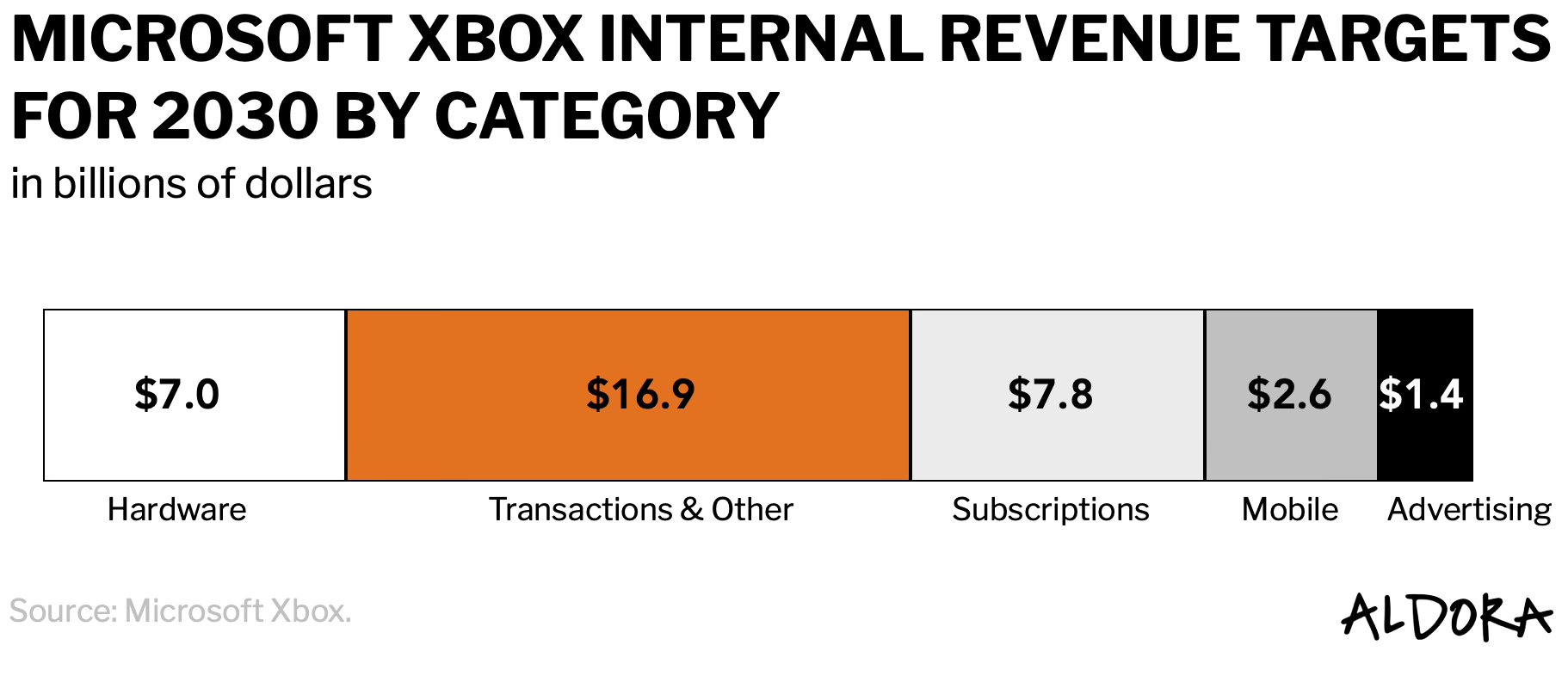
Already, competitors like Netflix and Amazon are rolling out casual services aimed at mainstream audiences that sing and dance to the same tune of ‘everyone plays,’ and compressing Game Pass’s upside. Matt Ball’s annual deck pointed to the increasingly competitive attention economy. The same applies here. Microsoft’s gaming business becomes a grind, and its single-digit growth stops looking like stability and starts looking like stagnation.
The second is external, and, in my opinion, more likely: an AI market correction.
It’s increasingly evident that AI may enter a corrective period. Rising valuations built on anticipated cash burn, absent clear revenue conversion at scale, will eventually collide with the force of financial gravity.
For example, OpenAI is expected to burn $218 billion in cash before reaching profitability, roughly equivalent to Ukraine’s GDP or 12 times what Uber spent. Those billions in pre-purchased compute capacity will need to be rationalized, and while depreciation timelines can be extended, that only smooths the optics. When that correction hits, a gaming business growing in the low single digits, even if it pulls in $5 to $6 billion annually in profits, won’t be existential to Microsoft.
Instead, Xbox may prove most valuable as a way to cushion some of the AI costs.
The uncomfortable follow-up: who would buy it?
Xbox generates roughly $20 billion in revenue, and with the hardware business increasingly given away, the operation is lean and transplantable. But assuming a valuation of, say, $100 billion, the buyer pool is limited. That makes the more realistic scenario a breakup.
That brings me to its subcomponents and studios.
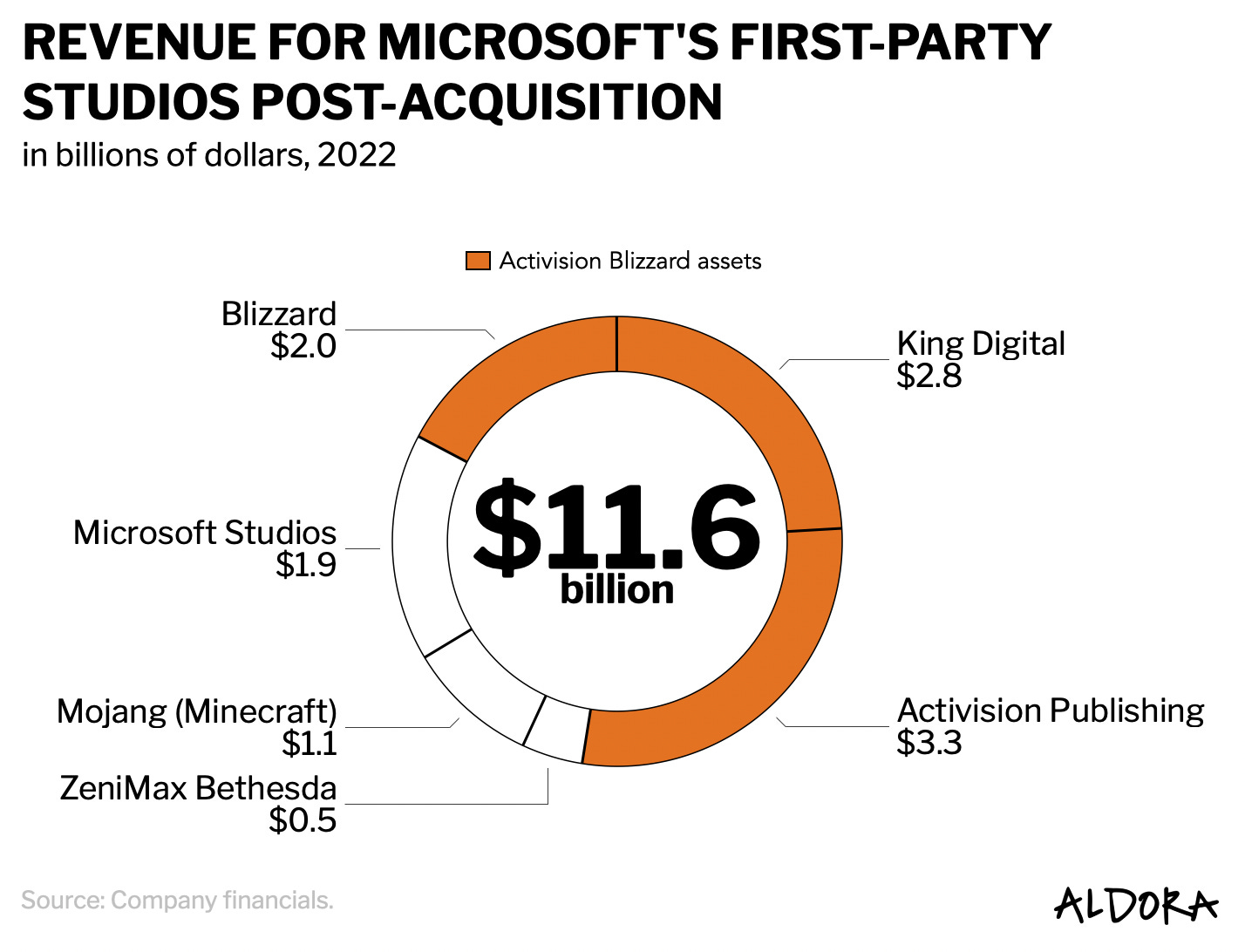
For instance, King Digital, which has been losing market share to newcomers, may be a key asset to sell off. This week, Gossip Harbor generated more revenue than Candy Crush, suggesting that the latter’s dominance is in decline. Additional pressure is coming from Turkish studios that excel at user acquisition. Scopely’s recent majority stake in Loom Games, an eight-month-old studio valued at nearly $1 billion, underscores how competitive the mobile landscape has become. Mobile is the least accretive to Game Pass, anyway, and therefore the most sellable. In contrast, AAA console properties are harder to value and harder to move.
Regardless of what asset will be sold off first, given a five-year time horizon, the current change in management marks the beginning of the end of the Xbox legacy as we know it. Too robust to collapse suddenly, the Xbox empire will instead gradually transform, recede, and divest.
There’s something almost structurally inevitable about it. Capital markets rarely allow such a large asset to simply fail. Instead, its components will be repositioned, reframed, and reallocated to justify their place in the corporate portfolio, or sold.
To avoid doing that, Microsoft will have to earn its credibility with players and developers all over again.
The $69 billion question is whether they can.
PLAY/PASS
Play. Discord has wisely delayed its age verification plans in the lead-up to its not-yet-announced IPO.
Pass. New York State’s attorney general is suing Valve over lootboxes, accusing it of promoting gambling.
NEXT UP
Doing my laundry, packing for SF and Austin.
Good take Joost!
Excellent thoughts on the future of MS. I fully agree with the divestiture of the assets over time
The issues, in my mind, started when the Xbox One released at $499. That marked a turning point where Xbox had come off the popularity and success of the 360 and squandered it by making the mistake PS had made the generation before. To your point, the inclusion of the Kinect and desire to transform living rooms was likely part of the MS plan back then (I.e. experimentation). However, it worked against them and started the platform on a path from which it has never recovered