

The Brainrot economy
If you don't get it, you're not invited

The SuperJoost Playlist is a weekly take on gaming, tech, and entertainment by business professor and author Joost van Dreunen.
Seattle is one of my favorite second-cities in the US.
It has the same mood as the place I grew up, but it’s prettier. The mountains are majestic, and there are just trees everywhere. And it’s coincidentally where some of my favorite game makers are located. It has something to do with spending lots of time indoors and inventing things to do. Like Finland.
I ended up spending a few days in Seattle for a slate of meetings and a panel hosted by GamesBeat. As industry discussions go, this one was actually well worth it. One highlight was our disagreement on how to answer Dean Takahashi’s question of whether the industry is currently going through a consolidation or a correction.
These are not opposites, I should point out. But even so, from where I sit, the industry is going through the latter. It’s been several years of overvaluations and high-profile M&A, and firms have started to focus more on efficiency and innovating on distribution (e.g., pricing models, handheld devices).
However, my fellow panelist from Zynga pointed out that mobile gaming has been experiencing a string of buyouts lately, suggesting a contraction. It’s true, of course, that there’s been more than a few acquisitions in recent months: AppLovin sold its games business to Tripledot, Playtika bought Superplay, and Scopely acquired Niantic’s Pokémon Go division.
And while mobile is large, roughly half of the entire industry, that doesn’t mean all of gaming is still consolidating. Arguably, especially the legacy console publishers and platforms have been shedding assets. It reminded me that high-level trends, such as consolidations or corrections, occur at different levels and on different timelines. We’ve become so accustomed to thinking of video games as a single form of entertainment that we may have come to view them as a unified economic activity. It isn’t.
Just because something is substantial doesn’t mean it behaves as a singular entity. It reminds me of a question I get frequently nowadays about living in the United States: “OMG, that country is nuts. What’s it like to even live there right now?”
Well, the new aspiring mayor of New York, Zohran Mamdani, organized a treasure hunt across Manhattan a few weekends ago. Even beautiful Seattle can’t top that.
On to this week’s update.
BIG READ: The Brainrot economy
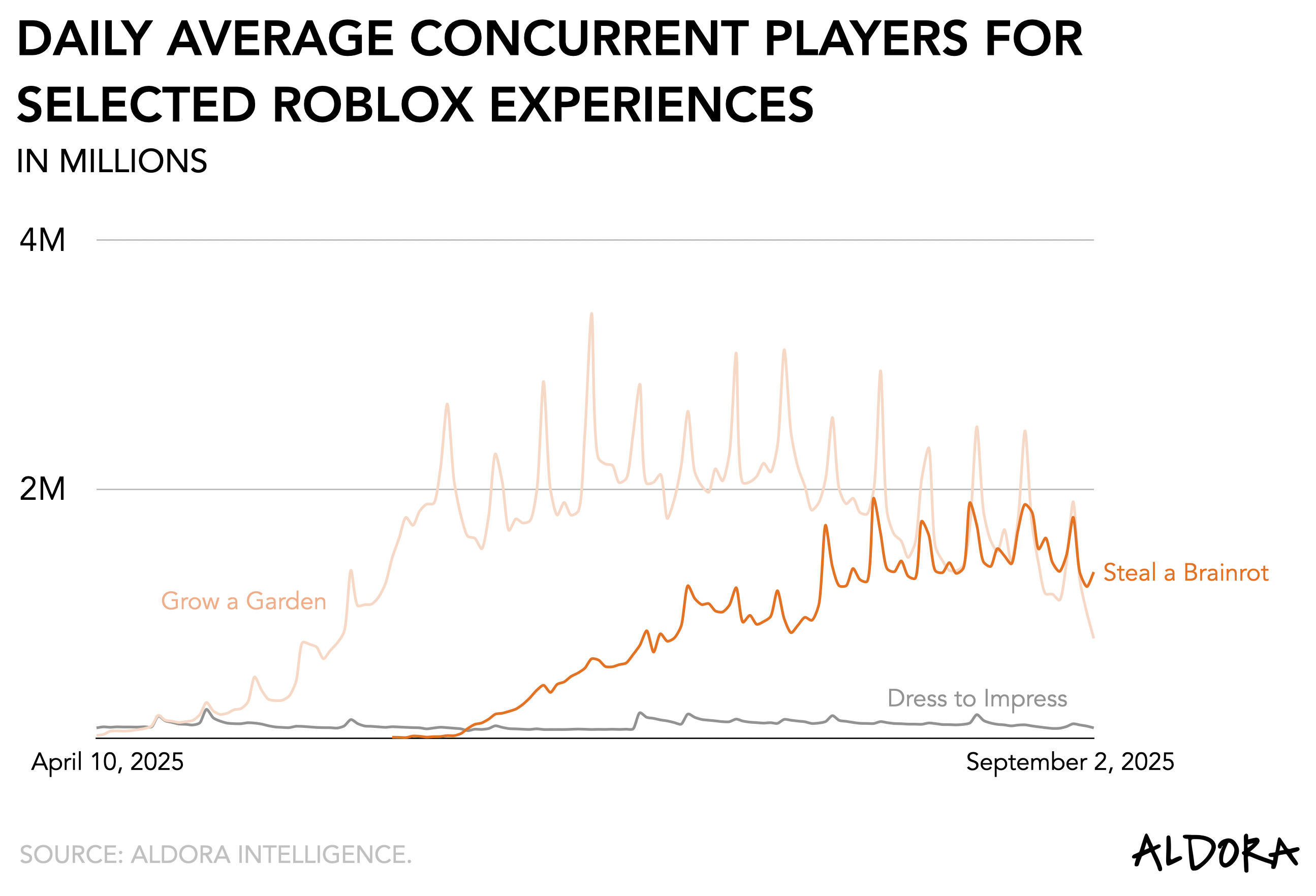
This past weekend, Roblox became the largest gaming platform in history by peak concurrency, reaching 47.4 million simultaneous users. That puts it above Steam’s all-time high of 40.3 million concurrent in-client users, and far ahead of its current daily peaks around 38 million. By raw numbers, Roblox is now the center of the interactive entertainment universe.
But, as you recall me saying elsewhere, bigger means different.
And Roblox's massive scale has fundamentally changed how it operates—inverting nearly every rule that's governed digital entertainment for the past two decades.
Consider Lady Gaga's recent attempt to connect with Roblox's audience. The pop star joined fans on the platform's Dress to Impress game on August 23 to promote her new single, "Dead Dance," part of Netflix's "Wednesday" franchise. The event peaked at 591,448 concurrent players—a number most conventional games would kill for.
But the execution was a disaster. Initially advertised as a chance to meet Lady Gaga herself, the event restricted actual interaction to influencers and campaign partners only. Regular fans were locked out, watching from the sidelines. Worse, Gaga herself appeared to phone it in, lounging on her bed with an iPad while thousands of fans waited. The organizers later apologized, but the damage had already been done.
Even a celebrity known for wearing a meat dress couldn't crack the code of authenticity in this new medium. That's because Roblox operates on an entirely different cultural logic.
Previously, easily accessible interactive entertainment—say, casual games—still followed a relatively straightforward product-based model. In the early 2000s, studios would launch their titles directly onto the internet (can you imagine?), charge $20 for it, and live to develop another day. Eventually, that model collapsed and fell to publishers like Big Fish, which promised you a new game every day. The idea was to offer a buffet and hope that people would stick around for that one exceptional experience.
Next, mobile came around. First hoping to charge a premium on par with Nintendo’s titles, it, too, quickly saw the bottom fall out. And once free-to-play had established itself as the dominant revenue model, mobile development became increasingly frantic and viral. Hypercasual games, which offer a minimal play experience and rely on ever-shorter development cycles, clutter the app stores. They became wildly popular, of course, like Subway Surfers on fentanyl.
Seeing Roblox’s latest fad, Steal a Brainrot, suggests we’ve turned yet another corner. The game revolves around players earning in-game money by collecting ‘brainrot’ characters and stealing them from other players.
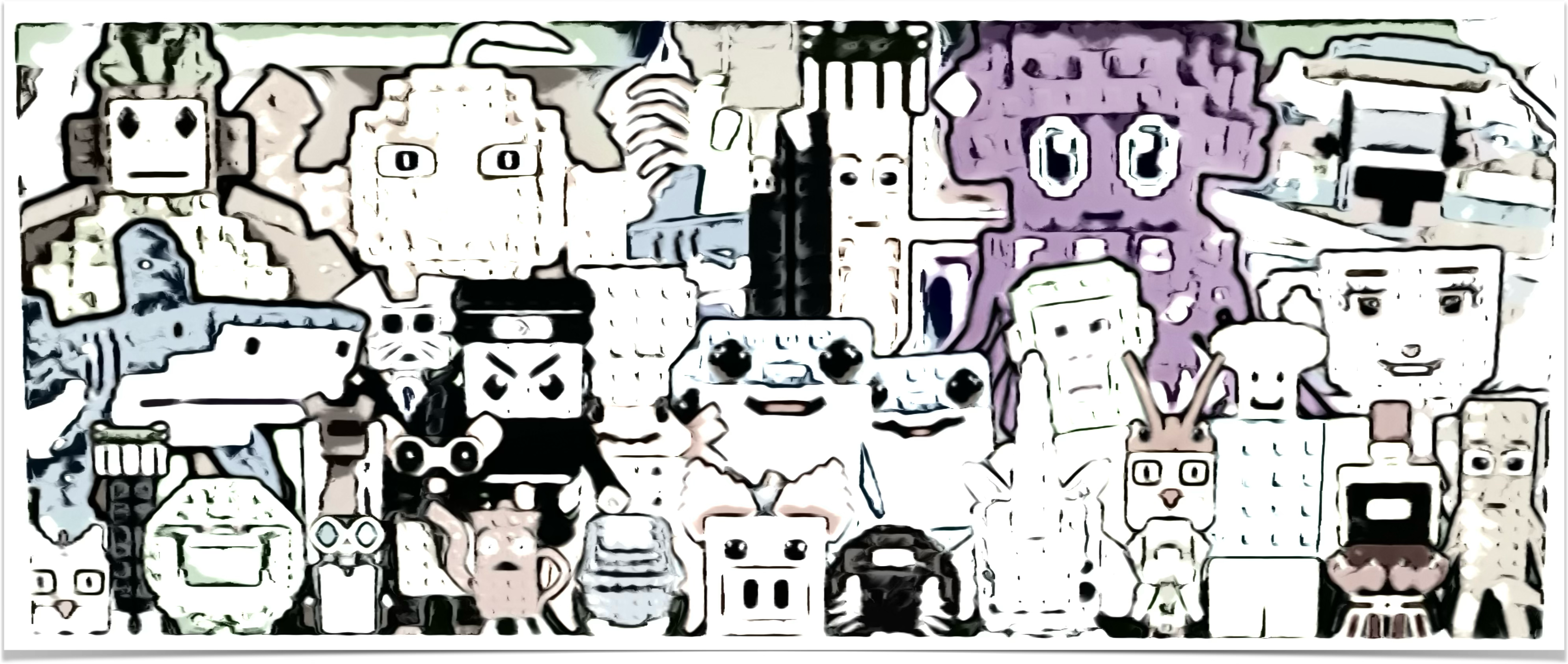
The game features an array of ridiculous characters, like Noobini Pizzanini, Ballerina Cappuccina, and Strawberry Elephant. Somewhere in the disorienting, chaotic gameplay, drenched in memes and YouTube-style references, you realize that, perhaps, this is the shape of what’s to come. Or rather, what’s already here.
Here’s the big idea: if it doesn’t make sense to you, maybe it’s not for you. The opacity is intentional. Just as punk, hip hop, or graffiti developed styles that alienated mainstream sensibilities, Roblox communities build games designed to feel inaccessible—or even irritating—to those outside the magic circle.
It’s brilliant, really. In a world powered by an emphasis on scale, this emergent form of play operates on a different cultural logic. Unlike traditional media industries, which build products and franchises designed to appeal to the broadest possible audience, Roblox inverts that logic. Its most powerful communities thrive on experiences that deliberately exclude outsiders.
The platform's exclusionary aesthetic makes these experiences appear frenetic, chaotic, and nonsensical to anyone who's not in on it. That's the entire point.
Another key component is that the Roblox ecosystem runs on velocity. Experiences go viral, spike into the millions, and then vanish. Production costs are low, and content is disposable. The comparison isn’t to AAA games but to reality TV: fast, formulaic, and perfectly tuned to stir strong reactions without lasting substance. It's not the cultural masterpiece we think we deserve, but quite possibly the kind of low-brow entertainment we actually need.
Other examples include Skibidi Toilet and Grow a Garden. The former—a tower-defense game based on a YouTube web-series featuring toilet-headed creatures in a dystopian setting—has become so popular that I recently found its action figures for sale at my local Target. The latter, a vegetable-growing game where players buy seeds and harvest crops in a never-ending loop, is the kind of interactive experience you get when someone on a different floor, in another room, whispers the words “Animal Crossing.” Yet these games are enormously popular—so much so that they continue to break player activity records.
It leads me to a few observations.
First, this is the new normal. Incumbent entertainment firms (see: Gaga) are struggling to orchestrate an authentic experience and compete for attention in an enormously popular market. They don’t matter as much. The deliberately frantic and nonsensical chaos presents an exclusionary experience that signals: if you can enjoy this, you're one of us.
Second, before dismissing this as low-brow culture that needs regulation, consider that this is how a new generation is defining its own digital space. I can't imagine coming of age in a world where the internet is as full of AI slop as it already is. Twelve-year-olds today will never accept digital information with the same reverence that many of us did when it was first presented. Or, as my own 12-year-old tells me, it's "boring."
Instead, the cacophony of games like Steal a Brainrot offers precisely all of the features that parents and politicians hate so much. It’s loud, chaotic, pits players against each other, and focuses on generating money, fighting, and stealing. These games are not meant to be the “best” or the “most polished.” They are designed to be excessive, to irritate outsiders, and to foster a sense of belonging among those inside. Somewhere along the industry’s quest to build ever more spectacular interactive experiences, Roblox found traction in the opposite: cheap, fast, and alienating.
For decades, violent video games were the flashpoint for adult anxiety about children's media. But cultural desensitization has blunted their edge. Nobody blames Call of Duty for corrupting the youth anymore. Instead, Roblox's aesthetic of chaos—its noisy, meme-driven, exclusionary spaces—has taken over that role.
Roblox's rise signals a structural shift in how digital culture is made and distributed. The unit of value is no longer the meticulously crafted blockbuster but the rapid-fire sensory experience. It exists to be felt by insiders and rejected by everyone else. Traditional game developers and entertainment companies will need to decide: keep chasing the broadest possible audience with polished products, or embrace the chaotic, exclusionary future that's already here. Given Roblox's numbers, the answer might already be decided.
NEWS
Paramount accepts the call of Call of Duty
Hollywood has spent the past decade circling gaming IP because it delivers what studios crave: built-in audiences and global cultural cachet. So Paramount’s decision to adapt Call of Duty into a live-action film makes sense. It’s one of the biggest franchises in entertainment, with nearly two decades of history and billions in revenue. The real risk isn’t whether fans will show up. They will. It’s whether the film can capture the intensity of the game without collapsing into a generic military blockbuster.
Paramount is hungry for growth. Its earlier foray with Halo fizzled after two unremarkable seasons, despite Microsoft’s backing. More recently, it spent $1.5 billion to secure the exclusive five-year global streaming rights for South Park (and promptly dropped a delightful Trump episode) in what appears to be a broader push for cultural relevance.
That history raises the stakes. Fans will be split. Some will show up out of curiosity—or pride—to see a cultural touchstone like Call of Duty hit the big screen. Others will remain skeptical, with good reason: most game adaptations flatten what makes the medium unique—interactivity, community, play. Recent wins like The Last of Us and Arcane have raised expectations. If Paramount treats this as just another action flick, gamers will shrug. However, if it leverages the franchise’s cultural significance and redefines the modern military genre, it could resonate far beyond gaming.
Just don’t expect a big-screen version of “No Russian.”
PLAY/PASS
Play. This week, Bloomberg had a good write-up on Nintendo, arguing that fun is a more sustainable long-term strategy than tech. Strong agree.
Pass. NetEase has shut down T-Minus Zero Entertainment, the studio led by Rich Vogel (ex-Ultima Online, Star Wars Galaxies, and Star Wars: The Old Republic), which was working on a new sci-fi co-op shooter.
UP NEXT
Summer’s ending, and the kiddos are back at school this week. Praise be.
I think before you jump to the conclusions that thousands of roblox creators, ranging from literal teenagers in bedrooms to distributed teams of professional devs, are all collectively deciding to make their game obtuse for the *explicit* sake of keeping out "outsiders" from their communities it might be worth considering a much simpler explanation. It's all F2P, as far as I know there's essentially no market for paid experiences. That, as you should know, warps what you make.
I'm not a Roblox player, but I work on a dev team that makes experiences for Horizon and is exploring Roblox. I don't see a platform full of punk-rock teens trying to exclude me at 32 with on the surface shitty games. I see a platform where the literal only way to make money is to be F2P, and an audience that's so conditioned to accept F2P game systems that they can be turned up to a higher degree than any old-head is used to or would accept. I certainly don't.
That and the devs are largely amateurs, and as you say the games are made fast. So of course they're going to be simple, cheap, unpolished, sometimes buggy with the shared aesthetic of other Roblox games. Bug again, I don't think anyone sets out to make something a 32 year old would hate so they leave. I just think a 32 year old isn't used to the swill, has money and knows they don't *need* to accept it.
Though I will admit, like growing up poor and learning to prefer the taste of processed foods, I do suspect growing up in this mileau is going to desensitize a generation towards cheaper-looking games with more F2P systems embedded within and it won't be off-putting. It'll just be normal. And that's a shame because I can't fucking stand F2P games
Seattle is also my favorite 2nd city in the US. Having lived and made games there, it also has the greatest boardgame stores I've ever been to (Card Kingdom, Mox Boarding House), incredible bars (due to the weather and long winter), and delicious coffee
You're spot on about the term "video game industry" being too much of a catch all. Back in 2015 I had taken a break from AAA development and was working in mobile. There was an arrogance and pervasive feeling with that crowd that it was the only thing that mattered (there's hubris on the AAA side as well, but I wasn't in the thick of that). A lot of it was around how they new everything and Console/PC didn't matter. Moreover, it was the idea that mobile was going to take over everything. Without going too deep into this, I was the canary who kept saying, "no, it won't. Console/PC will change, but the games people are playing are different. That is a different part of the industry." At that time I defined the two groups by there player motivations as time spenders (Console/PC) and time passers (mobile). The smashing together of these groups is like saying Soccer fans, concert goers, and ballet attendees are all the same. Sure, they are all engaged in viewing some sort of entertainment, but those interests are varied. Is there some crossover? Yes. Are they the same? Definitively no
I don't have a lot to add on the Roblox front as that's on the periphery of my world. Good observations though