
The one billion user strategy
Roblox and XBOX want the same thing. That doesn’t mean it’s the right goal

I’ve come down the mountain and now find myself back on the road. Seattle, my second-favorite American city, always manages to make me feel welcome. It also offers a reprieve before I insert myself into the multi-legged logistics involved in getting to Cologne for Gamescom. It’s a good thing I love airports.
As Summers go, this one has been a rollercoaster in terms of news and strategy updates. Both Sony and XBOX are making life-changing decisions, cutting jobs and cutting discs.
To a degree, many of the instructions currently handed down by management are still a correction of decisions made in the wake of the pandemic. The record spending that happened in the expectation that gaming was going to grow forever (forever-ever, forever-ever-ever?) has thus far largely resulted in heartache for players and developers.
Economies of scale are a favorite page in the tech industry’s playbook. But does it work equally well for gaming?
To make sense of that, I recently spoke with Joe Ploog, an assistant professor at IE University in Madrid. His work on digital entertainment and platform economics (together with Joost Rietveld, who recently got promoted to Professor of Business Strategy and Digital Markets at UCL School of Management. Congrats, big dog!) represents some of the more pioneering research answering these questions.
Ploog’s answer feels especially timely this week, as Roblox reports earnings and we get to watch, in real numbers, whether scale still buys growth, or whether the game has quietly shifted to who can keep players genuinely engaged.
On to this week’s update.

BIG READ: A billion daily active users
Given the major decisions coming down the pipe lately, it feels as though the biggest firms in the industry have run out of fresh ideas about what’s next. By now, we are painfully aware that cutting costs to preserve margins is part of the plan. But you can only economize so much before you have to address the much harder problem of what will be the source of innovation in the years ahead.
Currently, the industry remains dead set on a singular strategy: get bigger. Both Roblox and XBOX have declared their intent to reach one billion daily active users. Is that feasible? Sure. Probably. But is it enough of a strategic vision, especially in a cultural industry?
One answer is to first review and revise the existing notions that shape games today. Succinctly, somewhere along the line, the games industry has started to confuse itself with being a tech business. That worked well, for a while. But now it’s come to haunt it.
An important driver of the games industry’s growth has been its shift from a product-based business model to one where games function as a service. Instead of charging players upfront, they were invited in, for free, and it was up to developers to make gameplay and the broader set of related activities so compelling that players would naturally invest. Buying cool skins and in-game consumables are some examples, yes, but so is the time and attention players pour in. Arguably, that is the real currency here.
It is part of the reason why today we have only a handful of hyper-successful games like Fortnite, Minecraft, and Roblox that leave very little market share for any would-be competitor.
Big Tech Thinking
Perhaps the most enduring principle of games-as-a-service is positive network effects. As more people play a game, the game becomes more valuable and attractive to everyone. It has been a set piece among digital strategy for well over a decade now. The idea that game companies would offer a subsidized service (e.g., a subscription or free-to-play multiplayer title) that would lock in users as they develop friendships and routines is fairly common. It is also a principal backbone to much of the thinking among Big Tech, and, in turn, has become the same for game makers.
But are positive network effects, if well executed, a guarantee for success? And what happens when everyone in your market uses this same strategy?
The world of networked gaming has changed, and that has some notable implications for both individual games and platforms.
The mythology of network effects that more content attracts more users, making an ecosystem more valuable, works well when analyzing fax machines, ride-sharing companies, and other tech-based businesses, but falls short when it comes to culture industries.
According to a 2022 study, in fact, servers with more players are less successful at keeping players engaged. Developers who frequently update games and engage communities consistently outperform those chasing viral growth. By making their experiences more meaningful and engaging, rather than simply larger, developers can establish loyalty and a willingness to spend time and money.
I expect to see some of that materialize when Roblox reports its earnings this week. After posting a record 151.5 million daily active users back in Q3 2025, it has been losing some momentum in the quarters since.
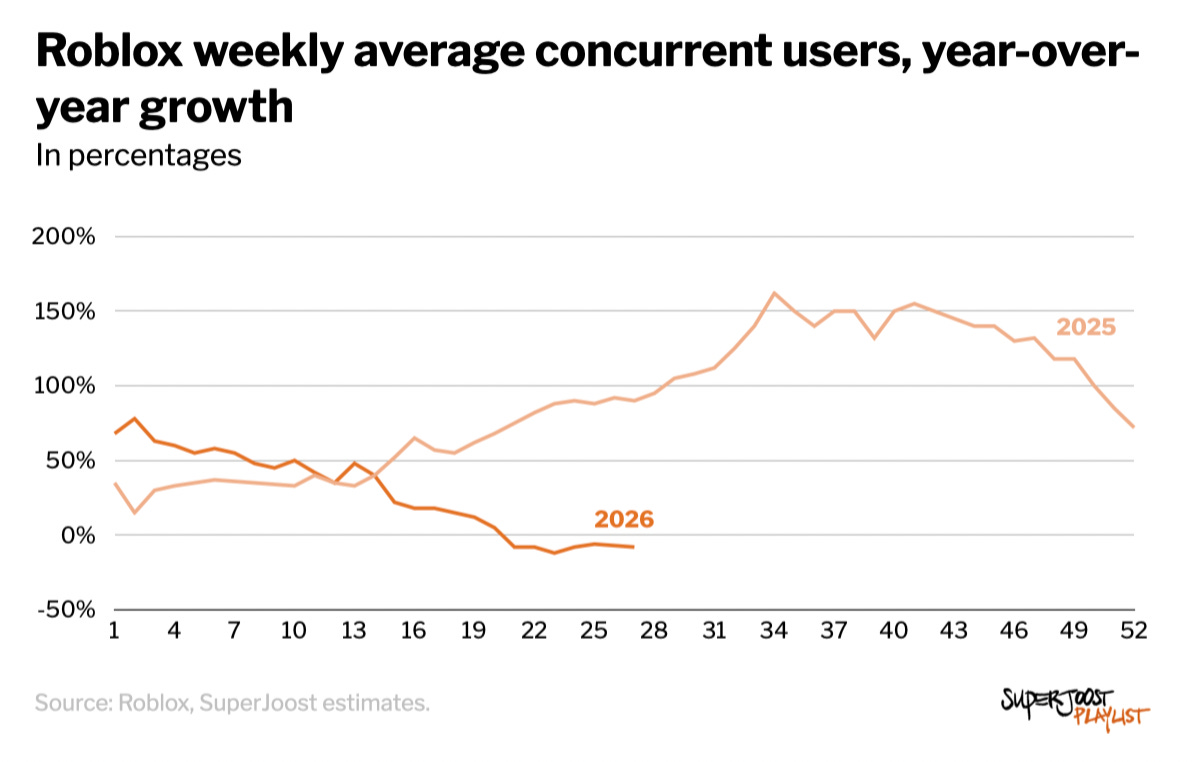
But, as Joe tells me, the strength of a network isn’t really measured by how many people show up—it’s measured by how involved they stay. “What you’re mainly competing on is not a download number,” he says. “It’s how much time a single individual is spending within your product.”
By that yardstick, the figure worth watching this week isn’t the headline daily active user count, which is bound to look soft against last summer’s viral peak, but the shape underneath it. Roblox’s peak concurrents have fallen more than a third from a year ago, as the Grow-a-Garden-scale spikes fail to repeat. At the same time, its trough concurrents, when platform activity is lowest, have climbed more than 20 percent. The ceiling is coming down, but the floor is rising. A platform that leans less on viral lightning and more on everyday habit is, counterintuitively, the healthier one, even if the growth chart looks like it’s pointed the wrong way.
All of which complicates the industry’s favorite round number. Both Roblox and XBOX have set their north star at a billion daily actives, but if Ploog is right, reaching a billion matters far less than what those billion people actually do once they’re inside.
You can find the recording of our full conversation below, including a summary.
🎙 OFFICE HOURS
Over the Summer period, I’m experimenting with live office hours: Tune in this Friday at 11:00 am ET when I’ll discuss this week’s headlines. If you have any questions, please submit them by replying to this email.
PLAY/PASS
Play. The big kid and I have been playing Carrion, which gives me OG Prince of Persia vibes. Only you get to be the terrifying monster this time.
Pass. I agree that Roblox needs to do a lot better when it comes to child safety. I disagree that Roblox is like ‘meth,’ as The Atlantic writes.
NEXT UP
I’ll be back in the woods in the coming weeks, preparing my syllabus for the upcoming semester. With my calendar still open, I’d love to hear your suggestions for a guest speaker!
Enjoyed the content, but especially enjoyed the Outkast reference and the Carrion picture at the beginning. Figured it was a visual metaphor for something that is ever-growing, until you mentioned that you're currently playing it. If you're ever looking for a coop metroidvania, I highly recommend Guacamelee. As for a guest speaker have you considered Mitch Lasky or Blake Robbins? They make the Gamecraft podcast which is very informative and right up your alley.