

The $100,000 developer surcharge
New visa fees reshape the cost structure of U.S. game development

The SuperJoost Playlist is a weekly take on gaming, tech, and entertainment by business professor and author Joost van Dreunen.
TLDR: The Trump administration’s new $100,000 fee on H-1B visas will make it harder for U.S. game companies to hire international talent.

The industry already gets less than 1 percent of all H-1Bs, but those hires have an outsized impact.

Instead of protecting American jobs, the surcharge will push work abroad, favor big publishers who can absorb the cost, and starve smaller studios of innovation.

The following argues that limits on foreign talent result in safer, less innovative games.

The real winners will be Europe and Asia, while the U.S. undercuts its own competitiveness.
The $100,000 developer surcharge
Over the weekend, I fell down a rabbit hole about how visa restrictions might reshape the US games industry. As a former H-1B visa beneficiary myself, I was struck by how much has changed. It made me curious about what it means for gaming companies trying to hire international talent.
Here's what I found.

The U.S. government’s new $100,000 annual fee on H-1B visas accelerates the erosion of U.S. competitiveness in the interactive entertainment industry.
Last week’s announcement that the Trump administration would add a six-figure fee to ‘specialty occupation’ work visas was depressingly on-brand. Across the board, the US is making it more expensive and cumbersome for international trade partners. After hitting the video game consumer market with tariff increases earlier this year, promptly resulting in Microsoft, PlayStation, and Nintendo raising the price of their consoles, it is now making labor more expensive.
I'll immediately admit that this doesn't sit well with me, for two reasons.
First, I held an H-1B visa myself for several years when I first arrived in the US. The visa application process is comparable to applying to graduate school—tedious and involved. If the enormous fees that exist today had been in place back then, I would have been unable to work in the US. It would have prevented me from starting a life here, building several companies, creating hundreds of jobs over the years, or becoming an investor. From where I sit, it would have been a net loss all around.
Second, I've also applied for H-1B visas for employees. It's a tedious process that stalls someone's ability to establish themselves, build their career, and start their life. The uncertainty is emotionally taxing—not knowing whether you'll be allowed to stay or forced to leave if denied. Even with a fully loaded legal team handling the paperwork, this is no picnic. It borders on cruel.
But never mind my big feelings. Let’s look at the numbers.
Playing with ire
Making it more expensive for international talent to work for US games companies is a demonstrably bad idea.
Creative industries rely on both domestically trained workers and international talent. Restricting one harms the other. Here Britain offers a cautionary tale. According to a 2019 study examining the economic impact of the UK's separation from the EU, one in four video game employers depended on non-UK nationals. It concluded that "plans to end freedom of movement imperil the creative industries and threaten further growth." The result has been predictable: firms shifted capacity abroad to stay competitive, weakening the UK's games industry in the absence of available domestic talent.
The U.S. risks repeating this mistake. Making it more expensive for domestic firms to source international talent doesn’t protect American video game jobs. Instead, it incentivizes outsourcing. Studios will relocate production to Canada, Europe, or Southeast Asia, where hiring talent is not subject to an additional six-figure tax.
Bureaucracy as gatekeeper
The application process is already challenging enough, apparently. Based on the available visa application documents, the process appears to be confusing, slow, and inconsistent.
A central sticking point is how credit is assigned in a highly collaborative field like interactive entertainment. To qualify, applicants must either hold a major international award or meet at least three out of ten criteria, such as industry awards, press coverage, judging others’ work, or holding critical roles.
The problem is that most recognition in games is collective. According to the U.S. Citizenship and Immigration Services,
“Participation in an award-winning project is not documentation of the individual’s receipt of a prize or award as the regulation requires.”
In other words, if your game wins a BAFTA but your name isn’t on the trophy, it doesn’t count. The same goes for media. In one case, filings that cited Kotaku and PC Gamer were rejected because “the digital material… did not specifically discuss the Beneficiary’s individual achievements.”
This results in a fundamental misalignment between how innovation operates in the real world and how bureaucracies define merit. Game development is a team sport. But U.S. immigration policy insists on solo performance.
The immigration framework was built for a 20th-century world of authors and auteurs. But gaming is a 21st-century networked medium. That mismatch is filtering out the very talent the industry needs.
A numbers game
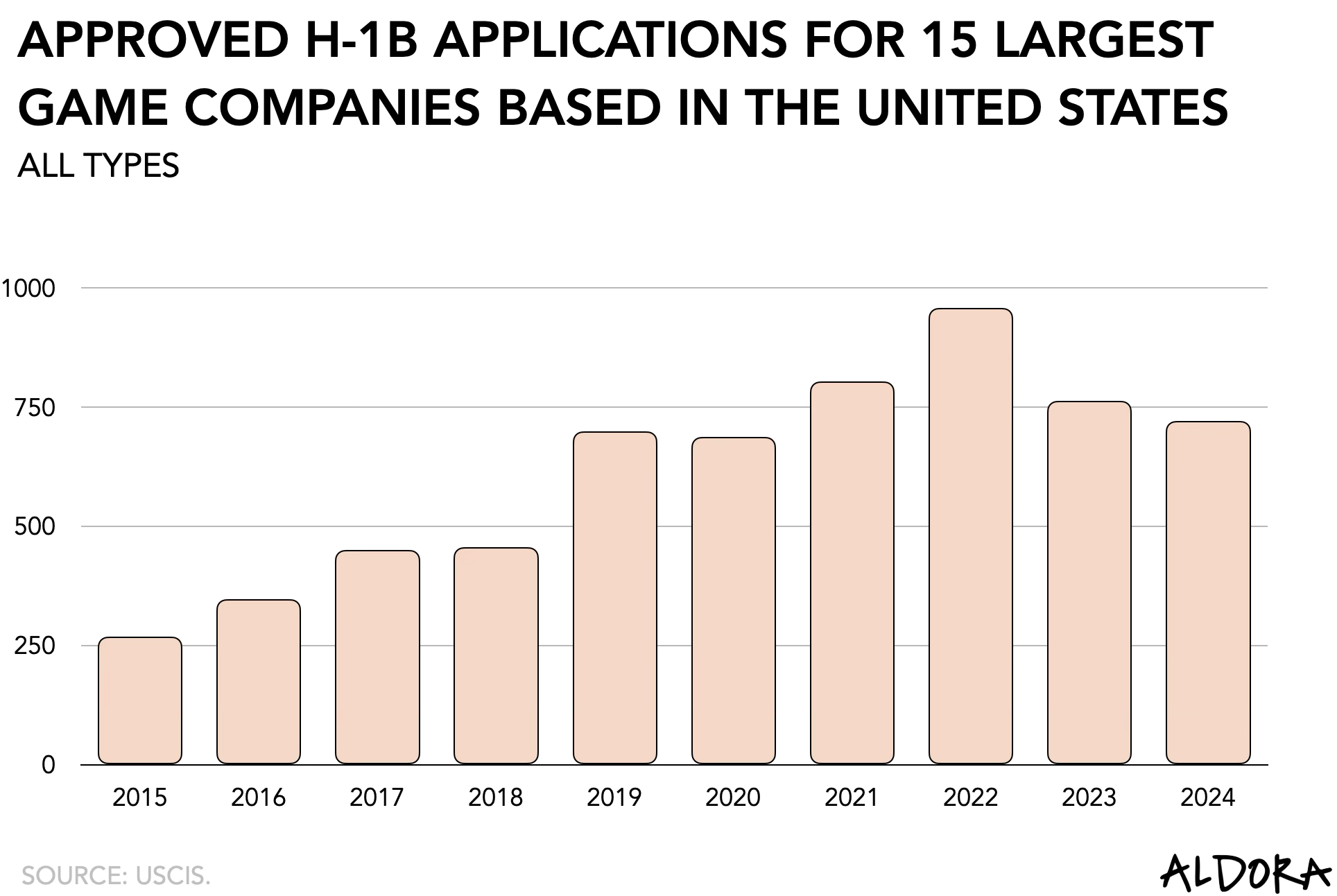
Stepping away from these specific examples, I also examined the broader picture: H-1B approvals from 2015 to 2024 among U.S.-based gaming companies with annual revenues exceeding $1 billion.1
Only 0.8% of all H-1B visas are allocated to the entire gaming industry. It tells you that we’re dealing with a tiny subset of highly specialized skills, but one that has an outsized impact.
I recorded a total of 5,689 6,161 H-1B approvals for the entire period—an average of 569 616 per year, with a peak of 899 in 2022. Congress mandates a maximum of 65,000 H-1B visas annually, plus an additional 20,000 visas for individuals holding graduate degrees.
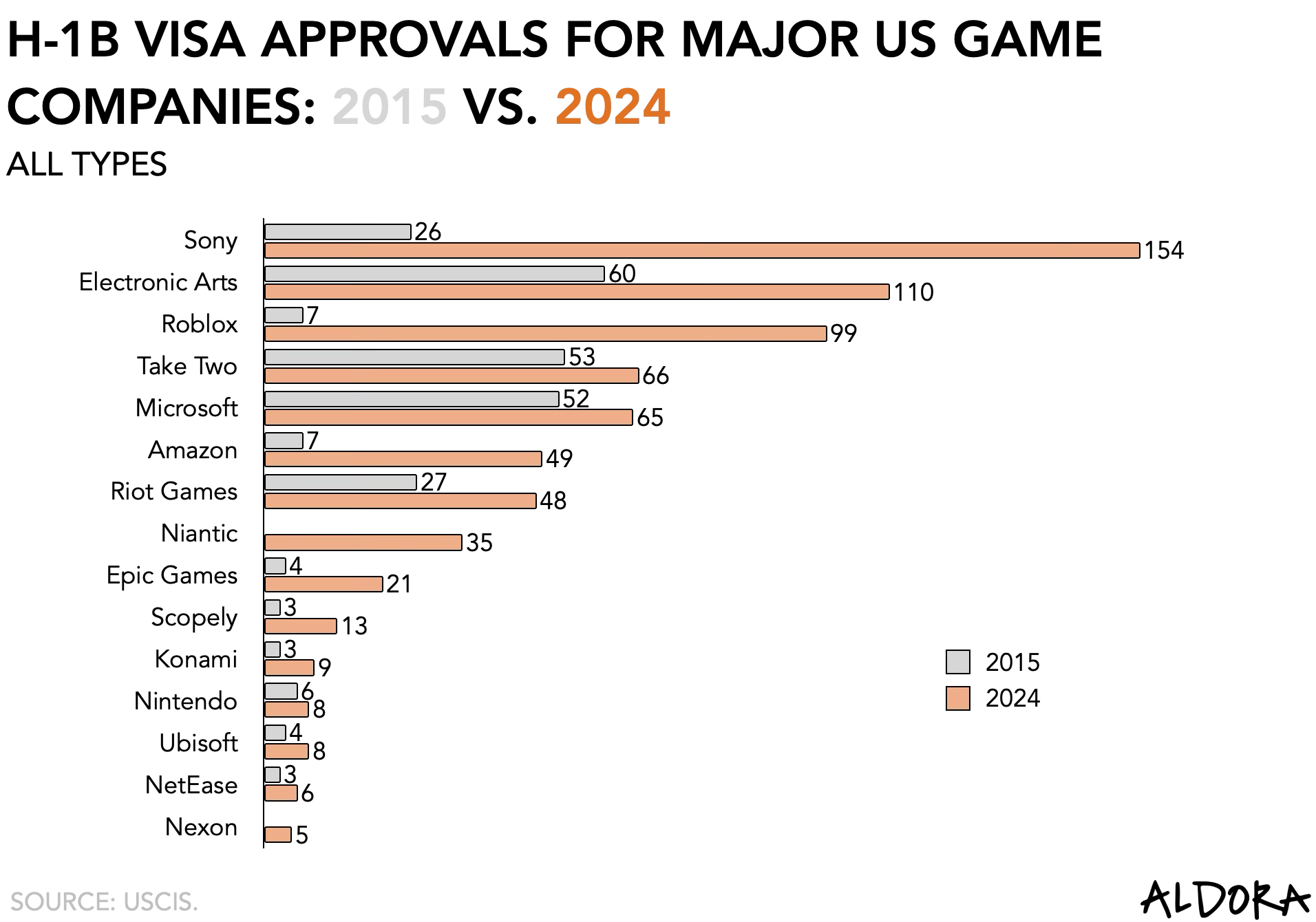
Among the gaming firms with the most applications, Sony is the number one, with 154 approved applications, down from 199 in 2022. Electronic Arts is second, with 110, and Roblox is third, with 99. Roblox shows the most dramatic increase, up from just seven applications a decade ago.
Microsoft (65 in 2024) and Amazon (49) appear smaller in the dataset because only applications filed under gaming subsidiaries (like Obsidian, Blizzard, or Twitch) are counted. Both firms likely issue many more H-1Bs (Amazon was at 94 for Twitch alone in 2021), and both are among the top ten sponsors overall.
The current dataset suggests that digital-first publishers have relied more on attracting foreign talent than their legacy peers. Even though the latter submits a substantial number of applications, those numbers have grown more modestly compared to digital-first firms like Roblox, Riot Games, Niantic, Epic Games, and others. Digital-native firms, which are often more reliant on engineering talent and have globally distributed workflows, rely on immigration channels as a critical input to innovation. Making it more challenging to access international talent will negatively impact the US industry’s ability to compete in a digital entertainment market.
[Edit: Due to a human error, by me, Riot Games was accidentally dropped from the tally. It is now correctly shown in the graph below. Thank you, Alli!]
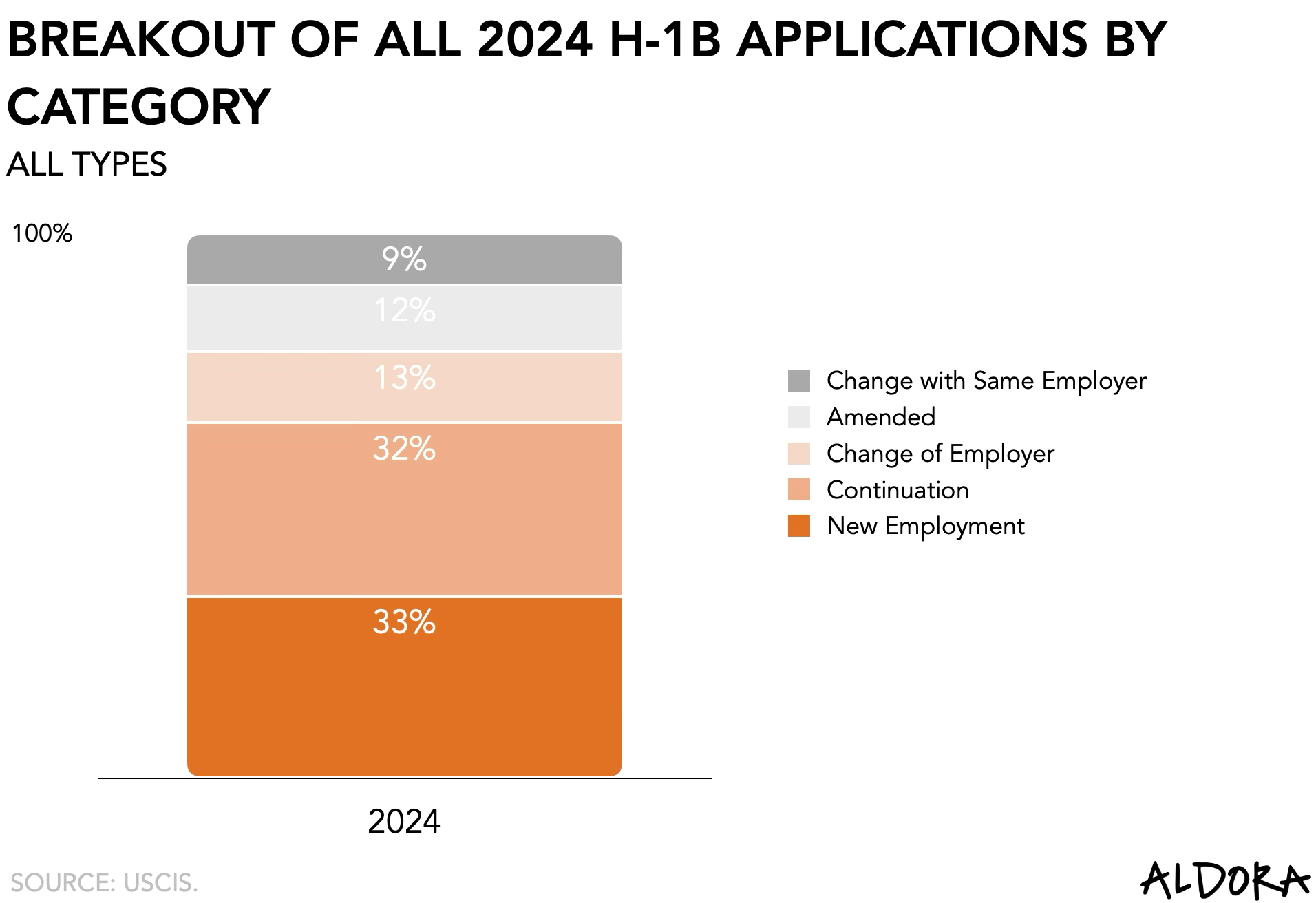
And because the new fee only applies to new applications, it’s worth distinguishing them. In 2024, only 34 33 percent of H-1B visas were for new roles. The rest were extensions, changes in employer, or shifts in position.
Targeting only new entrants might sound minor, but it discourages risk-taking, renewal, and upward mobility inside companies. Over time, that erodes the talent pipeline.
It leads me to the following predictions.
Visa fees will stifle innovation in the video games industry
The new fee structure suggests an additional annual cost of $23 million. That’s not an insurmountable amount, especially for the big firms. However, it is more likely to be a significant deterrent for smaller organizations, the kind where innovation is more likely to emerge. Unable or unwilling to carry the newly added costs, fewer smaller companies and foreign firms with US offices will apply. As a result, new H-1B visas will likely be awarded primarily to large publishers such as Electronic Arts, Take-Two, and Roblox, where economic efficiencies and shareholder interests often take precedence over innovation.
Rather than directing scarce visas toward firms with the highest marginal return on new talent—such as startups, creative labs, and experimental studios—the policy entrenches incumbents. The firms best able to absorb the cost are also those least likely to take creative risks.
This is largely confirmed by a 2022 study examining how restrictions on H-1B visas affect innovation in the U.S. console video game industry. Using data on more than 1,100 titles released between 2000 and 2007, the analysis shows that when firms had limited access to foreign technical talent, they compensated by relying more heavily on standardized development tools, such as game engines and physics engines. This substitution had clear trade-offs: games built with middleware sold better on average, but they were also less original, with novelty scores significantly lower than titles developed without these tools.
In effect, H-1B limits pushed studios toward safer, commercially viable products while reducing the scope for creative experimentation. Studios shift from pushing boundaries to optimizing known formulas, leading to a homogenization of output and a decline in long-term productivity growth across the sector.
America’s loss is Europe’s gain
As an unintended beneficiary of America’s self-sabotage, restrictions will bolster the European games industry. As applications decline—reserved only for senior roles—EU- and Asia-based firms will weigh how much $100,000 buys in travel, remote office upgrades, and relocation costs. Tax incentives and visa-friendly policies in Europe make the U.S. look less like the global magnet for talent and more like an overpriced hassle. Countries such as Ireland, Finland, and Germany stand to benefit from the infusion of digital talent.
Instead of building on its strengths in creative and high-skilled work, the U.S. is putting up roadblocks and pushing valuable jobs and ideas overseas. Talent is being shuffled around the globe, not by strategy, but by default. After years of innovative and ambitious people coming to the U.S. to work, these new rules won’t stop that flow but rather redirect it elsewhere.
Labor is the next front in the war on tech
This marks the start of more labor restrictions for American industries, and we're unlikely to have seen the last of it as the US administration remains intent on weakening its own economic and competitive position. I expect Big Tech to capitulate and pay these extra costs, both to stay in good favor and to leverage it as a competitive advantage against smaller competitors. At least, that’s what I think the US Secretary of Commerce meant when he said: “all of the big companies are on board. We’ve spoken to them.”
As a final observation, there's a distinct irony in this decision. Tech giants like Meta and Apple rely disproportionately on specialized foreign labor and have spent substantial efforts currying favor with the administration through donations. Now they find themselves on the receiving end of policies that directly harm their interests. The administration is effectively boiling the tech frog slowly, and Big Tech's placation strategy has predictably netted them nothing.
Like spending a fortune on a special permit only to be denied.
Data retrieved from the U.S. Citizenship and Immigration Services (USCIS) H-1B Employer Data Hub. Microsoft was excluded because its visa applications are filed under the parent company rather than individual subsidiaries, making it impossible to determine how many were allocated to gaming operations. Given Microsoft’s scale and its role as one of the top ten overall H-1B sponsors, including it would have distorted the sample relative to other publishers. The dataset, therefore, captures the reliance on foreign talent across the rest of the significant U.S. game firms without being skewed by the outlier.
THANK YOU for putting together such a cohesive argument for the economic benefits of H-1B. It's been disheartening to see conversation online devolve into American protectionism (if these experts were already in the US, they'd already be hired!) and racism (esp. against South East Asians).
Here's hoping tech and gaming companies get the memo on how little kowtowing to this administration actually benefits their businesses.
Stock Marxism is Nativist, so this could make for a fun Unboxing episode.