

Nintendo versus hyperscalers
The next generation of console gaming is shaping up different

After pressing ‘Submit’ for the last time, all final papers are in.
It’s been fascinating to see the prominence of AI grow with each batch, and this semester was no different. I’m nevertheless starting to develop mixed feelings.
For context, I allow, nay, encourage students to use AI in their work. The trade-off is that you tell me precisely how you used it, so I can tell where your own work ends and AI picks up.
The benefit, I think, is that you need to get comfortable.
When the seven most valuable firms in your economy have invested a cool trillion dollars in a novel technology, it will inevitably be part of your future experience. It serves my students well to be at least somewhat literate, and school is a good place to practice these skills before they are inevitably evaluated on them in the real world. Alternatively, maybe by exposing them early, this next generation may yet grow jaded before they’re lulled to sleep entirely.
Which is why my sympathies go out to the student who handed in a paper that ended with the sentence: “If you need the next part, I can turn this into the supporting charts/visuals section or combine everything into one polished final paper.” You figured out how to crack the safe and steal the jewels, but you forgot to leave.
The only real threat that AI poses is human error.
On to this week’s update.
BIG READ: Nintendo versus hyperscalers
Nintendo's price increase for its Switch 2 was both a notable break in the firm’s history and a glimpse into the future of console gaming.
When the console launched last June, it was already substantially more expensive than its predecessors, and presented a clear break with Nintendo’s historical pricing strategy. Sure enough, the firm is known for rarely lowering the cost of its hardware and games. In fact, that has been a central tenet of Nintendo’s strategy, as part of its pursuit of quality. Any discounts, former president and US COO Reggie Fils-Aimé told me recently, were retailers taking a loss to drive traffic. “The company never discounted,” he said.
But to have Nintendo announce a price increase is surprising.
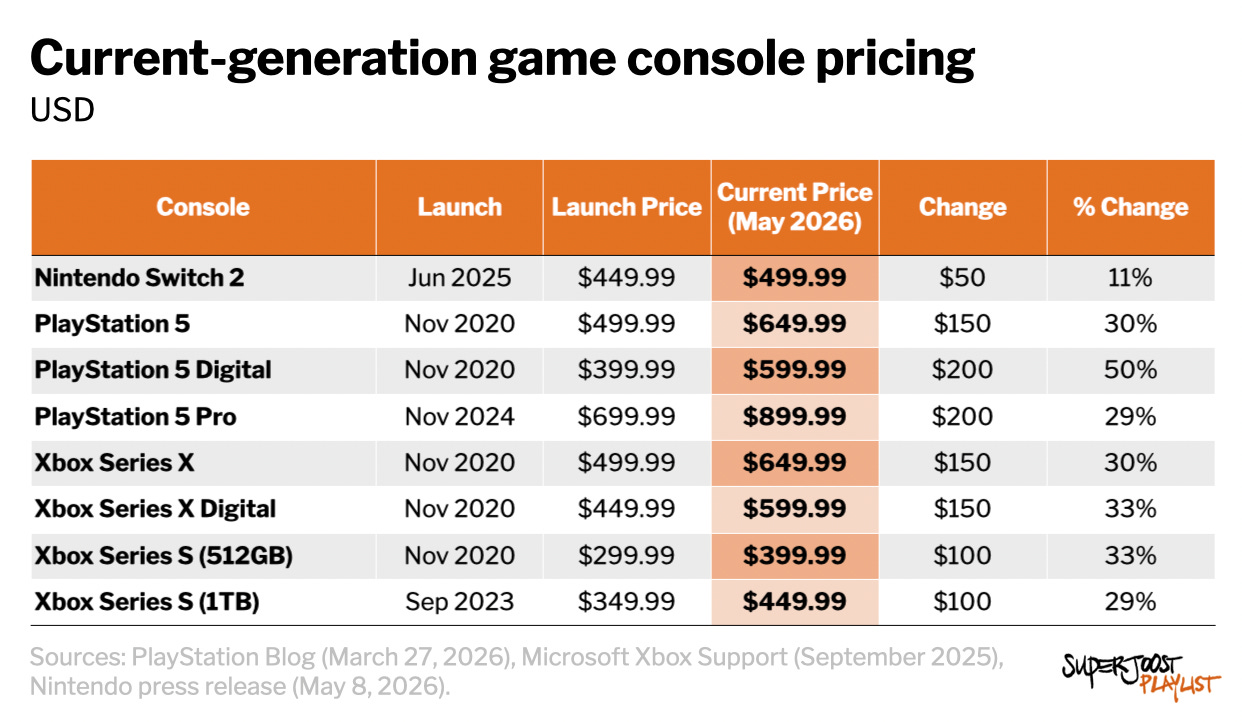
Starting in September, the Switch 2 will rise to $499.99 in the U.S., with parallel increases in Canada, Europe, and Japan. In addition, its Switch Online subscription is going up roughly 25 percent in Japan.
It forms a clear break with the firm’s long-standing pricing strategy, right as things were going well. The Switch is off to a strong start. It has sold close to 20 million units since its release in June 2025 and 49 million software units. The firm should be celebrating a triumphant launch. Instead, it tries to temper expectations. In its guidance, it warned of a softer year ahead, anticipating selling 16.5 million units and an 11 percent year-over-year revenue decline. President Shuntaro Furukawa apologized to shareholders and even conceded that the $50 price increase will not cover all of the cost inflation.
Nintendo’s stock fell 8.4 percent on the news to its lowest level since August 2024, and is down roughly 34 percent year-to-date.
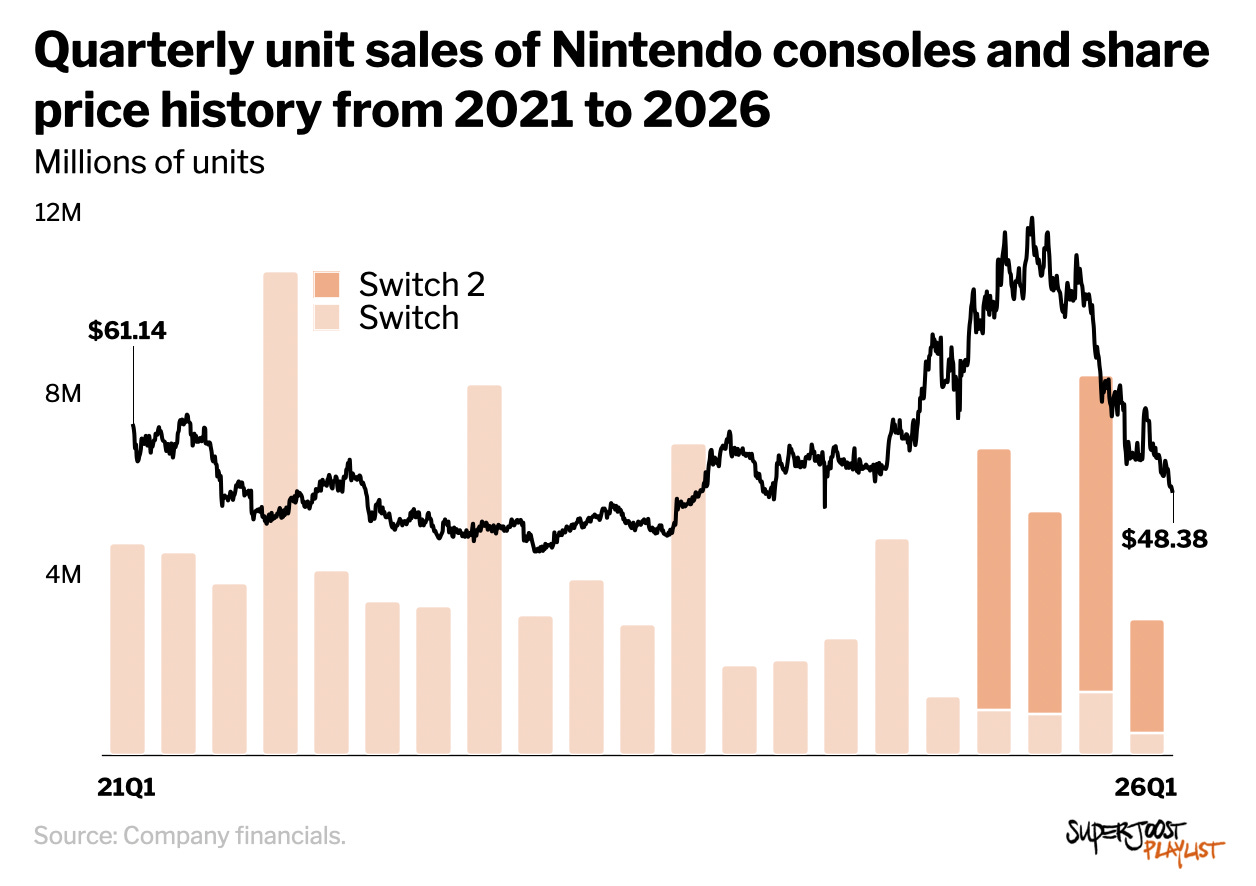
Forecasting a decline in sales during the second year of a recently released console is unusual. Historically, this is the time when console manufacturers benefit from price reductions, economies of scale, and a broader software library that attracts consumers who need more convincing.
The Switch 2 is doing the opposite. It is raising its price, lowering its volume expectations, and entering year two with the first-party slate still front-loaded with safe bets—Yoshi, Star Fox, and Splatoon Raiders—rather than the tentpole 3D Mario or Zelda titles that normally anchor a holiday window.
Nintendo’s circumstance is not unique.
In March, Sony similarly announced price updates for its current hardware generation, including an $899 price tag for the PlayStation 5 Pro. It puts the symbolic threshold of a $1,000 console within reach, effectively making the category a luxury expenditure. And Microsoft has done the same by raising Xbox Series X prices twice in 2025. It amounts to a pivotal moment in console gaming.
Historically, console makers cut prices as a generation matured. Even the famously expensive PS3 fell from $599 to $249 over its life. The Xbox 360 went from $399 to $199. The Wii dropped from $249 to $129. Every prior generation launched high, cut repeatedly, and ended its cycle at a fraction of the original sticker. The current generation has inverted that pattern in the US market. The devices have stayed the same but have become more expensive later in their cycles. AFAIK, this is the first time in the console business's 40-year history that this has happened.
This decision is largely the result of external factors. Three structural forces are simultaneously squeezing the console business.
First, memory is now wildly expensive.
The reason is obvious: AI companies are buying up all inventory to satiate their computational needs and thereby raising prices. Capital expenditure among hyperscalers is projected to exceed $725 billion in 2026 alone, and firms like Samsung, SK Hynix, and Micron are naturally allocating capacity to customers who sign the longest contracts at the highest prices. I’m told that chipset manufacturers like AMD see no near-term relief in sight on supply. Their capacity is maxxed out, and it takes years to expand production. Even the obvious alternative, cloud computing, merely moves the problem around but doesn’t solve anything as cloud providers compete for the same components.
There’s also the Hormuz closure, which has been in place since February 28. Shipping through the strait runs at roughly 5 percent of pre-war traffic, which has made oil, as well as insurance and container slots across every Asia-to-West lane, substantially more expensive. The memory of how a dragged down value chain impacted console sales, and the ability to deliver devices to consumers, should still be fresh in people’s minds.
And then there was the US tariffs that were announced in April last year.
Sure enough, the US Court of International Trade ruled Trump’s tariffs were unlawful, but the damage is obviously already done. Moreover, it’s but a single volley in a broader effort to construct trade barriers and artificial inefficiencies that raise prices. You’ll recall the 2024 report by the Consumer Technology Association, warning that tariffs could drive up the price of consoles by up to $246. Judging by where current MSRPs have landed, we are most of the way there.
Ready player when
Investors are divided on what this means for Nintendo. On the one hand, there are those who have started to lower Nintendo’s stock price. They argue that the “triple squeeze” on margins will have a more permanent impact on the new hardware cycle. They find evidence in the fact that there currently are no release dates for any of its marquee properties, like Mario and Zelda.
On the other hand, investors are looking to buy the dip. They argue that Nintendo recently reaffirmed the value of its Pokémon franchise with Pokopia and did, in fact, just launch the fastest-selling console in its history.
It tells you that the disagreement isn’t really about Nintendo or any of its peers. Rather, Nintendo is the canary in the coal mine.
A historically conservative, financially disciplined operator that builds its own hardware, owns its own IP, and answers to almost no one—and even Nintendo cannot absorb these costs without raising prices. If the most disciplined player in the category can’t hold the line, the rest of the industry has already been redrawing its plans. Sony has. Microsoft has. The question is no longer whether the pricing model needs to change. It is the version of the new model each company commits to.
So, what’s next?
As one would expect, Nintendo remains relatively insulated. For one, it retains over a quarter (27%) of its current market value in cash on its balance sheet. Considering Nintendo is not an acquisitive company, that money provides a buffer to navigate any additional financial uncertainty.
It has also established a credible new revenue stream through its box-office productions. To date, The Super Mario Galaxy Movie has earned $940 million on an $110 million budget. The previous film, The Super Mario Bros. Movie, generated $1.36 billion. What both productions lack in narrative structure, they make up for in profitability.
Another option is to announce the next iteration of either a new Mario or Zelda game. Here, I suspect Nintendo will disclose an upcoming title for April 2027 in the lead-up to this year’s holiday season. There’s no point in trying to go head-to-head against GTA VI, not even for Nintendo, so releasing a teaser in the latter part of the year will prime audiences to buy the new hardware in anticipation of a first-party Spring release.
A hard reset
None of the old rules—seven-year cycles, mid-cycle price cuts, predictable refresh windows, separable device-purchase decisions—survive the current environment intact. Forecasts built on the last cycle’s assumptions are already obsolete. What’s happening in console gaming is a direct reflection of what’s happening in the global economy.
For decades, the industry has been understood by investors, the press, and increasingly by its own executives, as a technology business.
But gaming is not a technology business. It is a cultural business that happens to run on technology. And while perhaps in the past growth came from better chips, its current value comes from the characters, franchises, and the social rituals built around them. Hardware is just a delivery mechanism.
The firms best positioned for what comes next are the ones that are developing novel ways to reach audiences and ways to play without the intermediation of large tech companies. A $4,000 price tag for NVIDIA’s latest RTX graphics card buys an epic ton of collectible cards and board games.
Nintendo’s price increase tells us that the existing economics for console gaming are breaking. The question now is whether the industry at large is going to recognize what it actually sells, and to whom—or whether it keeps insisting it is a technology business right up until the technology prices its customers out of the room.
PLAY/PASS
Pass. I’m still recovering from eBay’s formal rejection of GameStop’s offer, calling it “neither credible nor attractive.” Lol.
Play. The New York Times announced a televised game show based on Wordle that will air on NBC in 2027. Mario has movies, Cyberpunk got an anime, and now Wordle gets a quiz show.
UP NEXT
Take-Two reports earnings this week. Expect final confirmation of GTA VI’s November 19 release—and, if past is prologue, a new trailer to go with it.
[N.B. I’m sending this from the juror waiting room as I was summoned this week. The internet connection is what you’d expect it to be. I will correct any errors once I return to civilization.]