Epic decline
Judge the might of an empire by its champions

The SuperJoost Playlist is a weekly take on gaming, tech, and entertainment by business professor and author Joost van Dreunen.
It’s in the nature of empires to destroy themselves.
But instead of a sudden collapse, the root cause is often a gradual loss of control of the very systems that made them dominant in the first place.
The news of Epic Games’ latest layoffs adds to the mounting evidence of the real-time collapse of American cultural dominance in interactive entertainment. After decades of setting the tone for video games, US-based game makers face a bevy of strategic and economic challenges, forcing them to adapt to a new world order.
We can observe the signs of this decline when even the largest, most innovative, and most successful entertainment firms begin to struggle. As I see it, Epic Games is more than a casualty of bad timing or a bad quarter. It is the most legible example yet of what happens when structural conditions make decline inevitable.

Last week, it became painfully clear that, at long last, Fortnite’s cultural moment is starting to fade. Its active user count has been more or less stagnant for several years, in contrast to rivals like Roblox, which have grown. Even the investments and collaborations with Disney and LEGO have not led to sustained growth in the user base. And despite a well-executed strategy around the use of licensed IP (e.g., Star Wars, Marvel), its product market fit is waning.
Certainly, using someone else’s IP imposes a ceiling on creativity. You can play as Darth Vader, but you can’t make him your favorite color, give him wings, or bend him to your own aesthetic expression. In the absence of organic growth, Epic Games has spent a lot of time playing defense, ultimately leading to the firing of 1,000 employees.
As Bloomberg’s Jason Schreier observed, these layoffs are a symptom of more deep-seated problems. Companies spent the last decade chasing the live-service model that Fortnite pioneered, wasting billions in the process, he writes. The cruel irony is that even one of the OG free-to-play titles is proving unable to sustain itself.
Forever games, it turns out, aren’t.
By comparison, Roblox, for all its brainrot chaos, lets players create culture rather than consume it. Instead of playing in a world designed and shaped by incumbents, the comparatively unstructured playspace Roblox offers allows for greater expressive variety. There’s a reason why those Brainrot games are so jarring to your sensibilities. They are not for you.
But Schreier doesn’t take it far enough. Beyond the surface-level, Epic Games’ decline points to a cascade of market developments.
One major contributor now showing its true impact is the encroaching, disproportionate power wielded by platform holders. Over the ten years leading up to 2025, platform revenue, from app stores, console marketplaces, and digital storefronts, jumped from $14 billion to $41 billion, a 191 percent increase. By comparison, game publishers saw their revenue rise from $65 billion to $128 billion, a more modest 98 percent increase. Over the course of a decade, gatekeepers have captured value at nearly twice the rate of content creators.
In the United States, we now see what happens when platform holders gain disproportionate power in interactive entertainment. Unlike legacy platforms (ie, console makers), firms like Apple and Google don’t make games themselves and have little interest in cultivating a healthy ecosystem beyond their ability to extract revenue from it. A key example is Roblox, which is still financially vulnerable despite its massive success. Even with nearly 150 million daily active users, Roblox remains unprofitable. Instead of allowing publishers to offer discounts and benefits to their most avid players, platform firms have insisted on keeping as much economic activity as possible within the confines of their walled gardens.
After taking both Apple and Google to court, Epic Games is now licking its wounds. The cost of having taken on the firms at the top of the food chain is starting to materialize. Despite winning several important concessions, it has spent a fortune on lawyers and forfeited even more in lost opportunities. Before its removal from the App Store, Fortnite was generating an estimated $1-$2 million per day on iOS, or roughly $500 million annually. Even after Apple’s 30 percent cut, that’s $375 million in net revenue, every year, gone. Five years later, that totals close to $2 billion.
Some would go as far as to call it a Pyrrhic victory, a battle won at such great expense that it eventually means losing the war. Maybe. But given the enormous difficulty, even the most well-capitalized challengers cannot sustain prolonged conflict with platform incumbents economically.
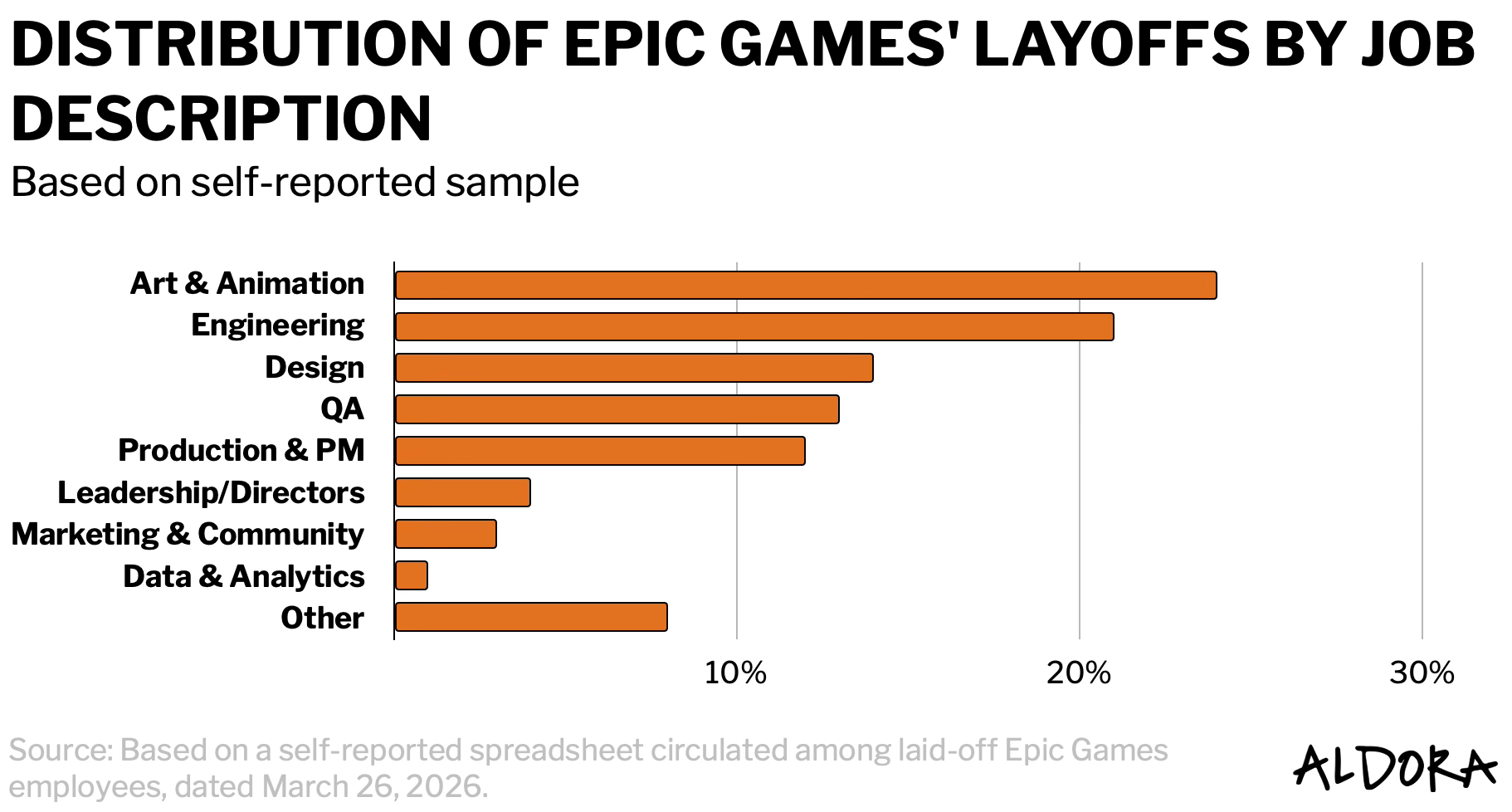
A look at the responsibilities held by those laid off makes the damage more tangible.
Based on a self-reported sample of 227 employees of the 1,000 that were just laid off, nearly half worked in art, animation, and design—the disciplines most responsible for what Fortnite looks and feels like. It suggests an incredible loss.